- By Admin
- Floor
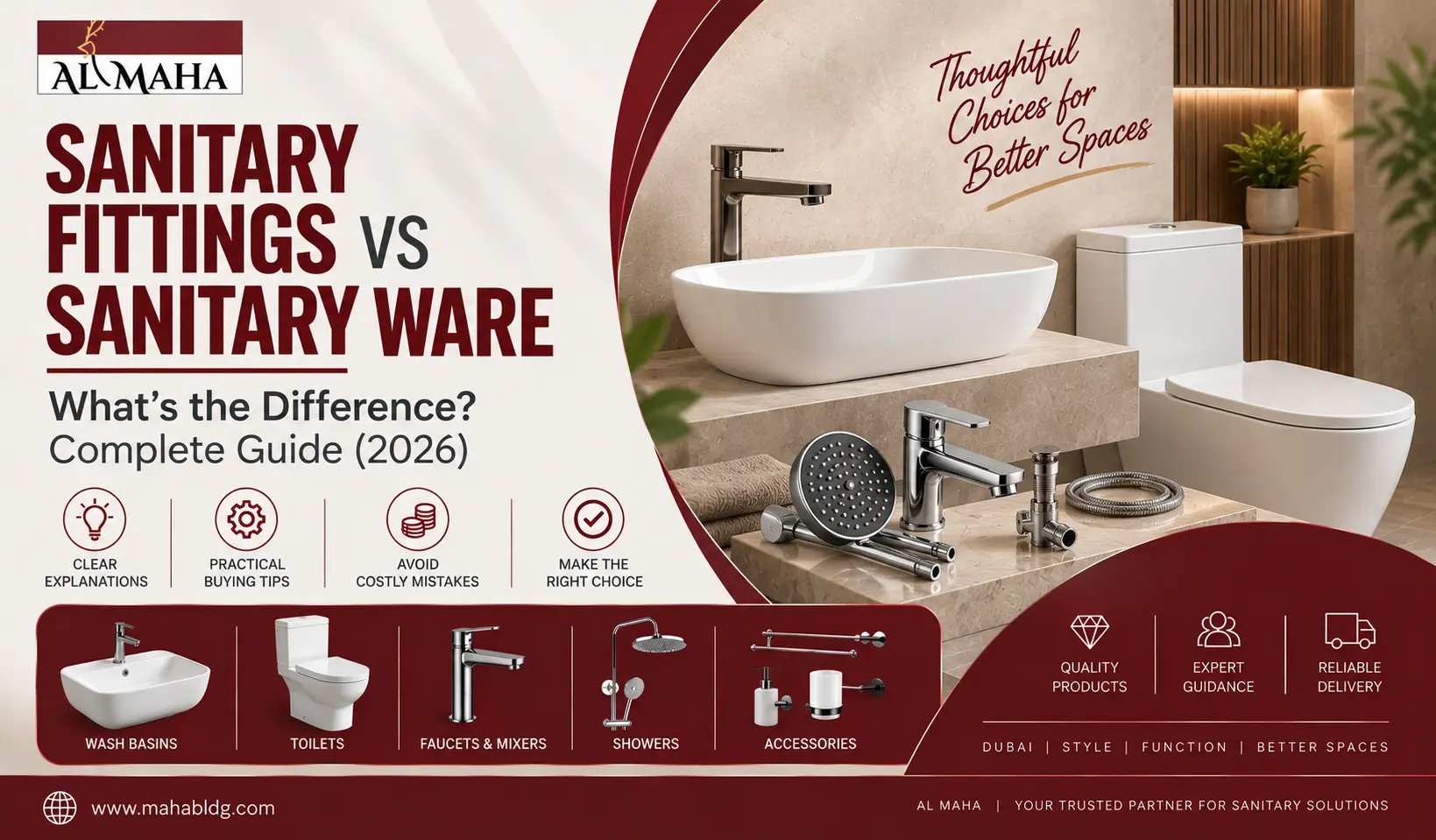
Sanitary Fittings vs Sanitary Ware: What's the Difference? Complete Guide (2026)
If you've ever handed a contractor a bathroom wish list and watched the quote come back thousands over budget, there's a good chance the confusion started with two words: fittings and ware. Suppliers use them constantly. Architects use them in drawings. And most homeowners nod along without actually knowing which is which.
That gap costs money. It causes the wrong faucet to show up for the wrong basin. It leads to "but I thought that was included" arguments between designers and plumbers. And on a renovation budget, it's usually the difference between a bathroom that works beautifully and one that leaks, rattles, or simply doesn't fit.
This guide breaks the two terms apart for good — what they mean, what they're made of, how to budget for both, and the compatibility mistakes almost nobody warns you about before you buy.
The One-Line Definition
Here's the short version, before we get into the detail:
Sanitary ware = the heavy, stationary hygiene fixtures. Toilets, washbasins, bidets, bathtubs.
Sanitary fittings = the hardware that controls water flow into and out of those fixtures. Faucets, mixers, valves, traps, flush systems.
Think of sanitary ware as the furniture of your bathroom and sanitary fittings as its plumbing nervous system. One holds water. The other decides where that water goes, how fast, and at what pressure.
Sanitary Ware, Explained
Sanitary ware is what most people picture when they think "bathroom." It's the vitreous china, fireclay, or acrylic fixture that stays exactly where it's installed for the next 15–20 years.
Common types of sanitary ware include:
Wall-hung and floor-mounted WCs (toilets)
One-piece and two-piece water closets
Countertop, wall-hung, and pedestal washbasins
Bidets
Bathtubs and shower trays
Urinals (commercial and residential)
Materials used in sanitary ware:
Vitreous china — the industry standard; dense, non-porous, easy to clean
Fireclay — heavier, often used for premium basins and farmhouse sinks
Acrylic — lightweight, common in bathtubs and shower trays
Sanitary ware is judged mostly on visual presence and hygiene performance. Glaze quality, resistance to staining, and how well the surface resists hairline cracking over time all matter more here than moving parts, because there aren't many moving parts to speak of.
If you're comparing options for a full bathroom refit, our sanitary ware buying guide for Dubai homes walks through how to shortlist fixtures by size, finish, and water-efficiency rating before you even talk fittings.
Sanitary Fittings, Explained
Sanitary fittings are the working hardware attached to — or connected between — those fixtures. They're what you actually touch every day: the tap you turn, the flush handle you press, the shower mixer you adjust.
Common types of sanitary fittings include:
Basin mixers and pillar taps
Wall-mounted and freestanding bath mixers
Shower mixers, diverters, and thermostatic valves
Angle valves (stop valves)
Bottle traps and P-traps
Flush valves and concealed cisterns
Health faucets and hand showers
Materials used in sanitary fittings:
Brass — the standard base metal for most taps and valves; corrosion-resistant and durable
Stainless steel — increasingly common for hygienic, commercial-grade fittings
Chrome plating — the most popular finish for residential fittings
PVD coating — a newer, more scratch- and tarnish-resistant finish used on premium ranges
Unlike sanitary ware, fittings do the mechanical work: sealing joints, regulating pressure, and directing flow exactly where it needs to go. That's why a fitting failure (a dripping tap, a leaking valve) shows up almost immediately, while a sanitary ware failure (a hairline crack in glaze) can take years to appear.
For a closer look at where fittings fit into a renovation plan, see our breakdown of sanitary fittings and how to select them, along with a full rundown of the different types of sanitary fittings available on the market today.
Why the Confusion Costs Real Money
Here's where most guides stop — definitions and materials. But the mix-up between these two categories causes three very specific, very expensive problems on real renovation sites.
1. Scope-of-Work Gaps
"Bathroom fixtures included" means different things to different contractors. Some quotes cover sanitary ware only, leaving fittings — often 30–40% of the total spend — as a separate line item the client didn't budget for. Always ask your supplier or contractor to specify, in writing, whether ware, fittings, or both are included in any quoted price.
2. Dimensional Mismatches (The "Will It Fit?" Problem)
This is the gap almost no buying guide addresses directly, and it's the single most common on-site headache:
A tall vessel faucet paired with a shallow countertop basin can cause splashing or overflow.
A single-hole basin can't accept a traditional two-handle pillar tap without drilling extra holes — or buying a different basin.
Wall-hung WCs need a concealed cistern and specific center-to-center rough-in measurements; a standard flush tank simply won't connect.
Before ordering anything, match these details on paper:
Ware Style | Fitting Requirement to Check |
Countertop / vessel basin | Tall-body basin mixer, correct spout height |
Single-hole basin | Single-lever mixer (not a spread-fit two-handle tap) |
Wall-hung WC | Concealed flush tank, in-wall carrier frame |
Freestanding bathtub | Floor-mounted or wall-mounted freestanding filler with correct reach |
Corner shower tray | Corner-configured mixer or diverter valve |
A five-minute measurement check at the quotation stage avoids a returned order — or a basin sitting in a box while the right tap gets shipped in.
3. Water Pressure Mismatches
This is the gap almost every competing guide skips entirely, and it's a real functional risk, not just a cosmetic one.
Thermostatic mixers and rain showers are built for pressurized systems and often need a minimum bar rating to function properly.
Gravity-fed tanks (common in older or villa-style buildings) deliver lower, inconsistent pressure — pairing them with a high-pressure-only fitting can mean a shower that barely trickles.
If your building relies on a gravity tank without a booster pump, look specifically for low-pressure-rated fittings, or budget for a pressure pump alongside your fitting purchase.
Ask your supplier for the fitting's minimum and maximum bar (or PSI) rating before buying — it's usually printed on the box or spec sheet, and it's the single easiest way to avoid a shower that underperforms after installation.
Budgeting: The Realistic Split
Most renovation budgets get sanitary ware and fittings backwards — people assume the toilet and basin are the expensive part, then get caught off guard by the fittings bill.
A workable allocation for most bathroom projects:
50–60% of budget → Sanitary ware. These are long-lasting, structural purchases you won't touch again for a decade or more, so it's worth spending toward the top of your range here.
40–50% of budget → Sanitary fittings. These see daily mechanical use, wear out faster, and are far more likely to need replacing or repairing mid-lifecycle — so don't undercut this category just to save money upfront.
If you're renovating on a tighter budget, our guide on how to save money on sanitary ware has practical ways to trim ware costs without giving up quality — which frees up more of the budget for fittings that actually need to perform well daily.
Maintenance and Longevity: What Actually Fails First
Both categories age differently, and knowing what to expect changes how you shop.
Sanitary ware failure points:
Glaze micro-cracking (especially on cheaper ceramic lines) — leads to staining and bacteria buildup over time
Yellowing on lower-grade acrylic bathtubs from prolonged UV or chemical cleaner exposure
Chipping at edges or drain holes from impact damage
Sanitary fittings failure points:
Hard water scaling reduces flow and can pit PVD or chrome finishes if not cleaned regularly
Rubber washers and cartridges inside mixers wear out, typically within 5–8 years of daily use
Cheaper chrome plating flakes or tarnishes faster than PVD-coated alternatives
Maintenance tips that extend both:
Wipe down chrome and PVD finishes with a soft cloth — avoid abrasive cleaners that scratch protective coatings
Descale aerators and showerheads every few months in hard-water areas
Re-seal ceramic ware grout lines annually to prevent water ingress and staining
Check angle valves and traps for slow drips before they become bigger leaks
Higher-grade brass fittings with PVD coating generally carry longer warranties (often 10+ years) than standard chrome, precisely because they resist the scaling and pitting that hard water causes over time.
Quick Reference: Ware vs Fittings at a Glance
Category | Sanitary Ware | Sanitary Fittings |
Examples | Toilets, basins, bathtubs, bidets | Taps, mixers, valves, traps, flush systems |
Primary material | Vitreous china, fireclay, acrylic | Brass, stainless steel, chrome, PVD |
Function | Holds water, hygiene surface | Controls, directs, and seals water flow |
Lifespan | 15–20+ years | 5–10 years (moving parts wear faster) |
Typical budget share | 50–60% | 40–50% |
Failure signs | Glaze cracks, staining, chipping | Drips, scaling, worn cartridges |
Making the Right Choice for Your Project
Whether you're finishing a single powder room or fitting out an entire villa, the same principle holds: ware and fittings are two separate purchasing decisions that have to be made together. Choose your basin or WC style first, confirm its exact rough-in and hole configuration, then select fittings rated for both that configuration and your building's water pressure.
If you're still deciding on styles and finishes, our guide on quality bathroom fixtures and our roundup of luxury bathroom design ideas with premium sanitary ware are good starting points for narrowing down a look before you shop for fittings to match. And once you're ready to move from the ware to the hardware, how to choose sanitary fittings covers the selection criteria in more depth — finish, valve type, and pressure rating included.
Get this pairing right from the start, and you avoid the two most common renovation headaches: a fixture that doesn't fit its fitting, and a fitting that doesn't fit the building's water system. Get it wrong, and you're looking at return shipments, delayed installs, or a shower that never quite works the way the showroom sample promised.
The bottom line: sanitary ware is the fixture, sanitary fittings are the hardware that makes it functional — and a bathroom only performs as well as the weaker link between the two.
Frequently Asked Questions
Is a shower head sanitary ware or a sanitary fitting?
A shower head is a sanitary fitting. It's a mechanical component that directs and shapes water flow, not a fixed hygiene fixture. The shower tray beneath it, on the other hand, counts as sanitary ware.
Do plumbers usually supply both, or just one category?
It varies by contractor. Some plumbing quotes include fittings only and expect the client to supply ware separately, while others bundle both. Always confirm in writing which categories a quote covers before signing off, so you're not left sourcing one half of the bathroom at the last minute.
Can I mix brands between sanitary ware and sanitary fittings?
Yes, in most cases. Ware and fittings from different brands are usually compatible as long as the fitting's hole configuration, spout height, and pressure rating match the ware's specifications. Matching brands can simplify warranty claims, but it's not a functional requirement.
Why do my new fittings feel low pressure even though the tap is rated for high pressure?
This usually points to a building water-supply mismatch rather than a faulty fitting. High-pressure-rated fittings need a pressurized system to perform as designed; if your building relies on a gravity-fed tank, even a premium mixer will feel underwhelming until a booster pump is added.
How often should sanitary fittings be replaced?
Most brass fittings with quality finishes last 8–10 years before internal cartridges or washers need replacing. Cheaper chrome-plated fittings in hard-water areas may show scaling or pitting within 3–5 years, which is often the first visible sign that a replacement — not just a clean — is needed.
Does sanitary ware need replacing as often as fittings?
No. Ware is far more durable when it comes to daily wear because it has no moving parts. A quality vitreous china basin or WC will typically outlast two or three generations of fittings, provided the glaze isn't damaged and the surface is cleaned with non-abrasive products.

 18 Sep, 2026