- By Admin
- Floor
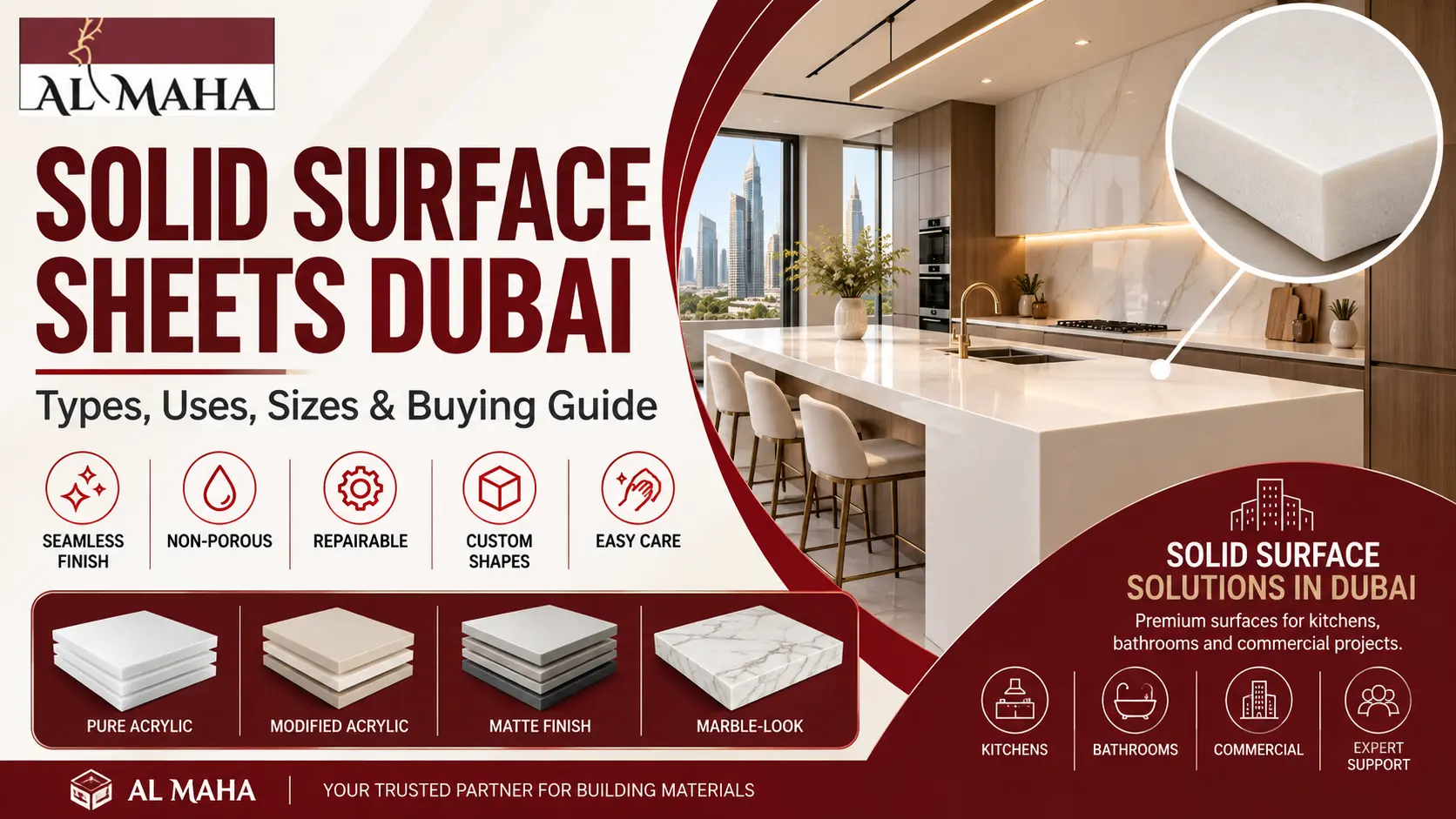
Solid Surface Sheets Dubai: Types, Uses, Sizes & Buying Guide
Solid surface sheets are everywhere in Dubai. Hotel reception desks. Hospital counters. Kitchen islands in Dubai Hills villas. Retail kiosks in malls.
The reason is simple. The material looks seamless, cleans easily and can be shaped into almost anything.
But buying it is not simple. Two sheets can look identical and perform very differently. One costs far more than the other. Thickness, resin type and supplier all change the outcome.
This guide walks you through what you actually need to know before you buy solid surface sheets in Dubai. We cover types, sizes, uses, climate performance, pricing factors, supplier checks and care.
What Is a Solid Surface Sheet?
A solid surface sheet is a man-made panel. It is made from mineral filler (usually aluminium trihydrate) bound with resin and pigment. The colour runs all the way through the panel, not just on the top layer.
That is the key difference from laminate. A laminate sheet is a thin printed layer bonded to a board. Scratch it deeply and you see the core. A solid surface sheet is the same material throughout. Scratches can be sanded out.
People search for it under many names: solid acrylic sheet, acrylic solid surface sheet, or simply Corian sheets. Corian is a brand name, much like Hoover for vacuum cleaners. Many other brands make comparable products.
Key properties
Non-porous. Liquids and bacteria do not soak in.
Seamless joints. Panels are bonded and sanded so the join is almost invisible.
Repairable. Surface damage can usually be buffed or sanded out.
Workable. Fabricators cut, rout and drill it with woodworking tools.
Thermoformable. Heated, it bends into curves and 3D shapes.
Types of Solid Surface Sheets: Pure Acrylic vs Modified Acrylic
This is the part most suppliers skip. It is also the part that affects your budget the most.
Not every sheet sold as "acrylic solid surface" is pure acrylic. The market has three broad tiers.
Type | Resin | Best for | Limitations |
100% acrylic (pure acrylic) | Acrylic (PMMA) | Curved work, thermoforming, premium kitchens, healthcare, exterior-exposed areas | Highest price |
Modified acrylic (acrylic-polyester blend) | Acrylic plus polyester | Flat indoor surfaces, vanity tops, wall panels | Less flexible when thermoformed; may yellow or fade faster in strong light |
Polyester-based | Polyester | Budget flat indoor work | Brittle under heat forming; lower UV stability |
Which one should you choose?
Choose pure acrylic if:
You need curves, bends or sculpted shapes.
The surface will see strong sunlight or sit near a window wall.
The job is healthcare, hospitality or a signature residential project.
You want the longest lifespan.
Choose modified acrylic if:
The design is flat and indoors.
The budget is tight.
It is a short-to-medium life retail or office fit-out.
Ask every supplier one question: "What is the resin composition of this sheet?" A reputable dealer answers clearly and shows a datasheet. If the answer is vague, move on.
Corian and other brands
DuPont Corian is the best-known name. People often type white Corian sheet into search when they want a clean, bright, neutral panel. Other international and regional brands sit alongside it at different price points.
A brand name alone does not guarantee quality. Check the warranty, the batch consistency and whether the supplier is an authorised dealer. If you want a starting point for filler and sheet ranges, see the solid surface filler sheets available at Maha Building Materials.
Standard Sizes and Thickness Guide
Most solid surface sheets in the UAE follow a standard format.
Common sheet size: 760 mm × 3,680 mm (about 2.8 m²)
Imperial equivalents: 30 in × 96 in, and 36 in × 120 in
Common thicknesses: 6 mm, 9 mm and 12 mm
Always confirm the exact dimensions before ordering. Sizes vary slightly between brands, and your cutting plan depends on it.
Thickness selection matrix
Thickness | Typical use | Why |
6 mm | Wall cladding, shower panels, furniture facings, vertical surfaces | Lighter, cheaper, no load-bearing need |
9 mm | Vanity tops (with support), shelving, partitions | Middle option for light-duty horizontal work |
12 mm | Kitchen countertops, reception desks, bar tops, work surfaces | Strong enough for horizontal use with proper support |
A simple rule: 6 mm for walls, 12 mm for anything people lean on.
Countertops are often fabricated with a built-up edge so the 12 mm top looks 25 mm or thicker. That is a fabrication detail, not a different sheet.
Plan your wastage
A 760 mm width limits layout choices. Long runs need joins. Good fabricators place joins in low-visibility spots and colour-match them. Ask to see a sample joint before you approve the job.
Colours and Finishes
Solid surface comes in a wide range of looks.
Plain whites and neutrals. The most popular category by far.
Marble-inspired. Veined patterns without natural stone's porosity.
Granular and speckled. Good at hiding daily marks.
Bold and dark tones. Popular in hospitality and retail.
Finishes matter as much as colour:
Matte. Hides fingerprints and light wear. Looks modern.
Satin. The practical middle ground.
High gloss. Dramatic, but shows scratches sooner.
If you like the veined look but want a natural option, compare it with marble and granite. Our guide to marble vs granite in Dubai explains how stone behaves differently from engineered surfaces.
Top Uses of Solid Surface Across Dubai Projects
Residential
Kitchen countertops and islands
Bathroom vanity tops
Shower walls and niches
Window sills
Built-in furniture
Homeowners like the seamless look. No grout lines means fewer places for dirt to hide.
Commercial fit-outs
Reception desks
Retail counters and display units
Office pantry tops
Meeting tables
Branded kiosks
Fit-out contractors value speed. Sheets cut and install quickly, and fabricators can match brand colours.
Healthcare
Clinics, laboratories and hospitals use solid surface for nurse stations, reception counters, lab benches and wall protection. The reasons are practical:
Non-porous surface, so it resists staining and bacterial growth
Seamless joints, with no grout to harbour germs
Compatible with standard disinfectants
Hospitality
Hotels use it for lobby desks, bar tops, bathroom vanities and sculpted features. Thermoforming lets designers create curved reception counters that stone cannot match.
Wall cladding
Solid surface wall panels give a clean, joint-free finish in bathrooms and feature walls. If you are weighing it against tile, read our overview of cladding tiles in Dubai and our page on cladding tiles fixing.
Bathrooms
Solid surface pairs well with modern fittings. For ideas on pairing materials, browse sanitary ware and these luxury bathroom design ideas.
Performance in the UAE Climate
Dubai is tough on materials. Summer ambient temperatures regularly pass 45°C. Humidity is high on the coast. Sun exposure is intense. Here is how solid surface copes.
Heat
Solid surface handles normal indoor heat well. It does not like direct contact with very hot pans. A trivet is essential in kitchens. Thermal shock can cause cracking, especially near cooktops and on lighter colours.
UV and sunlight
UV is the big question. Pure acrylic holds colour better under strong light than modified or polyester sheets. For areas near full-height glazing, choose pure acrylic and ask the supplier about UV stability. For fully exposed outdoor use, get written confirmation that the specific product is rated for it. Many interior-grade sheets are not.
Thermal expansion
Solid surface expands and contracts with temperature. In long runs, installers leave small expansion gaps and use flexible fixings. Skipping this step is a common cause of cracked joints. Ask your fabricator how they handle it. A good one answers in seconds.
Humidity and moisture
Because the material is non-porous, it handles humidity and wet areas well. That makes it a strong choice for bathrooms, kitchens and laundry areas. Seal edges and cut-outs properly, especially around sink bowls.
Practical tips for Dubai
Keep the A/C running during installation so panels do not shift in extreme heat.
Store sheets flat and indoors before fabrication.
Avoid leaving sheets in direct sun on site.
Estimated Price Guide for Sheets in Dubai: AED Rates in Dubai
Solid surface pricing is rarely published. Here is a realistic way to think about it.
Note: The figures below are indicative ranges to help you budget. Actual rates change with brand, colour, thickness and market conditions. Request a written quote before you commit.
Item | Indicative range |
Modified acrylic sheet, 6 mm | Lower tier |
Modified acrylic sheet, 12 mm | Lower to mid tier |
100% acrylic sheet, 12 mm | Mid to premium tier |
Premium branded sheet (Corian-type), 12 mm | Premium tier |
Fabrication and installation | Quoted per linear metre or per m² |
What drives the price
The sheet is only part of the cost. Watch these factors:
Resin type. Pure acrylic costs more than modified blends.
Brand. Premium names carry a premium.
Colour. Dark, veined and special colours often cost more than standard whites.
Thickness. 12 mm costs more than 6 mm.
Complexity. Curves, integrated sinks and sculpted edges add labour.
Wastage. Poor layouts burn material.
Installation. Site access, floor level and finishing affect labour.
How to compare quotes fairly
Make sure each quote states:
Brand and resin type
Thickness
Colour code
Whether fabrication and installation are included
Warranty terms
Delivery and VAT
A cheap quote that leaves out installation or uses modified acrylic is not a cheaper deal. It is a different product.
For a wider view of budgeting building materials, our building materials in Dubai guide is a useful companion.
How to Choose the Right Supplier and Fabricator in Dubai
Most buyers search for Corian sheet dealers or a solid surface sheets manufacturer and then compare quotes. Price should be one factor, not the only one.
Supplier and fabricator are often different companies. Know which one you are talking to.
Supplier checklist
Authorised dealer status. Ask for proof if you are buying a named brand.
Stock availability. Check colours and thicknesses are in stock, not "on order."
Batch consistency. Sheets for the same job should come from the same batch to avoid colour shifts.
Technical datasheets. The supplier should provide them without fuss.
Delivery. Ask about lead times across the UAE.
Samples. A physical sample beats any catalogue.
The same logic applies to other materials. Our guide on choosing a tile supplier in Dubai covers questions that work for any building material.
Fabricator checklist
Past projects you can see, ideally in person
Workshop with CNC cutting and thermoforming capability
Clear joint-making process
Written warranty on workmanship
Insurance for site work
A site survey before final cutting
Compliance in Dubai
Commercial projects must meet local rules. Do not leave this to the last week.
Fire safety. Dubai Civil Defense requires materials in many commercial settings to meet specific fire performance requirements. Ask for fire test certificates for the exact product, and confirm the classification your project needs with your consultant.
Healthcare standards. Clinical fit-outs follow Dubai Health Authority (DHA) requirements for hygienic, easy-to-clean surfaces. Seamless, non-porous material suits these needs, but confirm your project's specific requirements with your consultant.
Documentation. Keep material approvals, datasheets and test reports on file. Consultants and authorities often ask for them.
Rules change. Always verify current requirements with the relevant authority or your project consultant before you finalise the material.
Red flags
No datasheet or test certificate
Refusal to name the resin type
Prices far below every other quote
No physical sample
Vague warranty wording
Care, Maintenance and Scratch Repair
Solid surface is low-maintenance, not no-maintenance. A few habits keep it looking new for years.
Daily cleaning
Wipe with warm water and mild soap.
Use a soft cloth or sponge.
Dry the surface to avoid water spots on dark colours.
Stain removal
Light marks: Use a non-abrasive cleaner with a damp cloth.
Stubborn stains: Apply a mild household cleaner and rub gently.
Dried spills: Soak first, then wipe. Do not scrape with metal.
Scratch repair by finish
Matte finish:
Clean the area.
Rub lightly with a fine abrasive pad in a circular motion.
Wipe clean and check the result.
Repeat if needed, then blend the surrounding area.
Satin finish:
Use a fine abrasive pad, moving in one direction.
Blend the edges so the repair is not visible.
Wipe clean.
Gloss finish:
Gloss needs a polishing compound after sanding. This is a job for a professional. DIY attempts often leave dull patches.
For deep scratches, burns or chips, call your fabricator. They can sand and refinish the area or insert a patch.
What to avoid
Hot pans placed straight on the surface
Harsh solvents and strong paint removers
Cutting directly on the surface
Dragging heavy objects across it
Final Thoughts
Solid surface sheets give you a clean, durable and flexible surface for homes, clinics, hotels and offices across Dubai. The right choice depends on three things: the resin type, the thickness and the supplier behind it.
Get samples. Ask for datasheets. Compare quotes line by line. Confirm compliance early.
Ready to explore your options? Browse our full product categories, see the solid surface filler sheets range, or contact our team with your project details. You can also learn more about AL Maha Building Materials in our website.
Frequently Asked Questions
Is solid surface the same as Corian?
Not exactly. Corian is one brand of solid surface. Other brands make similar materials, and quality varies.
Is solid surface better than quartz?
It depends on the job. Quartz is harder and more heat-tolerant. Solid surface is seamless, repairable and can be thermoformed. Choose based on the design and use.
Can I use solid surface outdoors?
Only if the specific product is rated for it. Check with the supplier in writing, and choose pure acrylic for sun-exposed areas.
How long does it last?
With proper care, a quality installation lasts many years. Pure acrylic generally ages better than lower-grade blends.
Can it be repaired?
Yes. Light scratches buff out. Deeper damage can be sanded or patched by a fabricator.
 09 Oct, 2026