- By Admin
- Floor
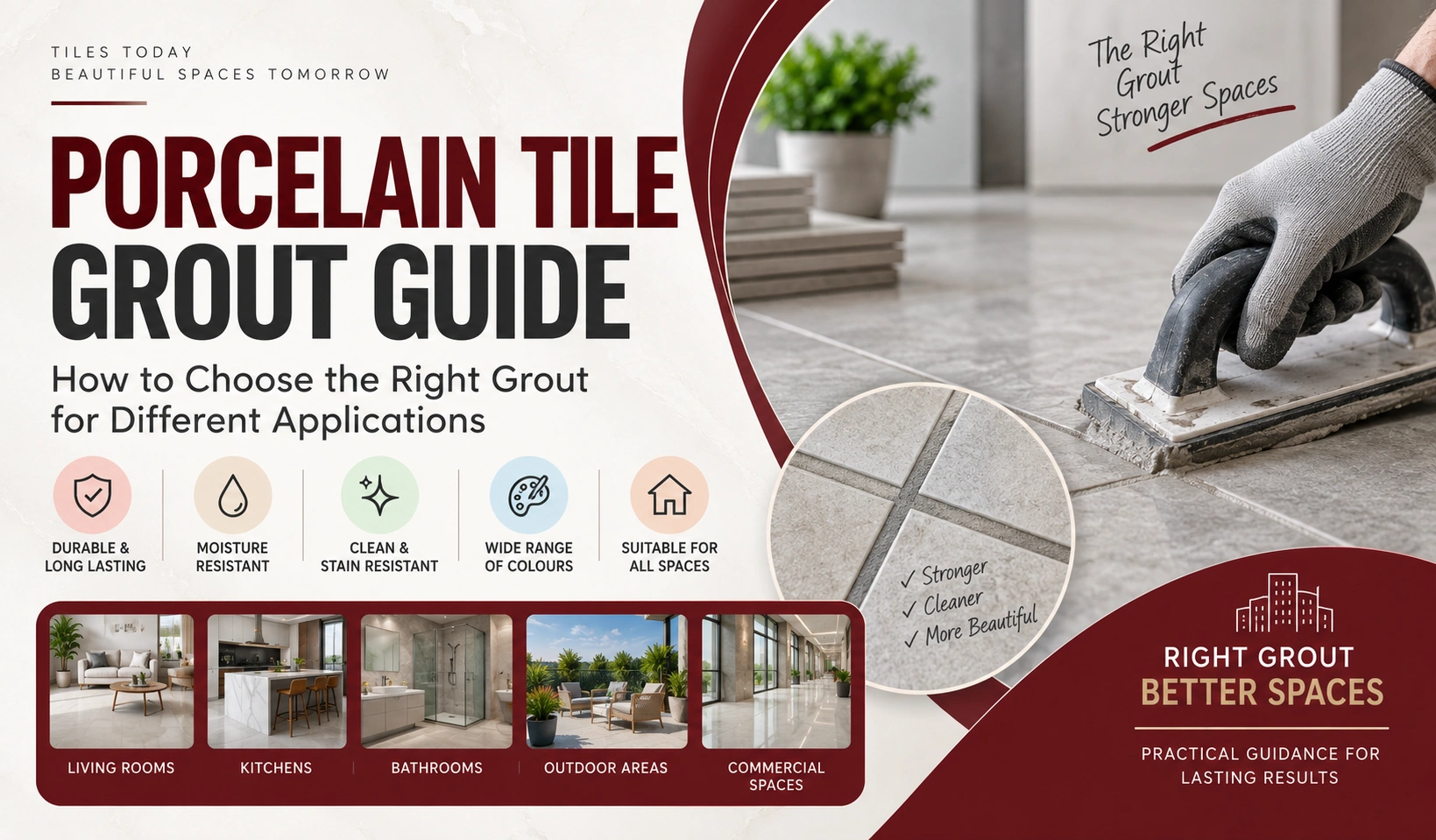
Porcelain Tile Grout Guide: How to Choose the Right Grout for Different Applications
Choosing the right grout is an important part of a successful porcelain tile installation. Porcelain tiles are dense, durable and low in water absorption, but the grout joints still need to handle moisture, cleaning, foot traffic, temperature changes and everyday movement.
The wrong grout can lead to problems such as cracking, staining, discolouration, water penetration, difficult maintenance and an inconsistent finish.
For homes, villas, commercial buildings, bathrooms, kitchens, balconies and outdoor spaces in Dubai, grout selection should be based on the tile application, joint width, moisture exposure, traffic, cleaning requirements and desired appearance.
This Porcelain Tile Grout Guide explains the main grout options and how to select the right solution for different porcelain tile applications.
What Is Tile Grout?
Grout is the material used to fill the joints between tiles after the tiles have been installed with an appropriate adhesive.
It serves several purposes:
Fills spaces between tiles
Creates a finished appearance
Helps protect tile joints
Makes tiled surfaces easier to maintain
Supports the overall installation system
Provides an opportunity to create a coordinated or contrasting design
Grout should not be treated as a substitute for proper tile installation. The substrate, adhesive, tile alignment and joint design all contribute to the performance of the finished surface.
Al Maha Building Materials' existing porcelain tile installation guide also highlights joint width, application location, moisture exposure, traffic, cleaning requirements and colour as important factors when selecting grout.
Why Choosing the Right Grout Matters
Porcelain tiles themselves are highly resistant to moisture, but the joints between tiles have different characteristics.
The grout selection becomes particularly important in areas exposed to:
Water
Humidity
Heavy foot traffic
Food and grease
Cleaning chemicals
Outdoor temperature changes
Dirt and staining
Frequent maintenance
For example, the grout required for a bedroom floor does not necessarily need the same performance characteristics as grout used in a shower area or commercial kitchen.
A good selection starts by identifying the environment in which the porcelain tiles will be installed.
Main Types of Grout for Porcelain Tiles
The two major categories relevant to many porcelain tile installations are cementitious grout and epoxy grout.
Grout Type | Best Applications | Main Characteristics |
Cementitious grout | General floors, walls, residential areas | Practical, versatile and available in many colours |
Polymer-modified cementitious grout | Residential and commercial applications | Improved performance compared with basic cementitious grout |
Epoxy grout | Demanding wet, commercial and hygiene-sensitive areas | High resistance to staining, moisture and chemicals |
MAPEI's technical documentation identifies cementitious and epoxy grouts as distinct grout categories, with different performance characteristics and applications.
1. Cementitious Grout
Cementitious grout is one of the most widely used grout categories for ceramic and porcelain tile installations.
Modern cementitious grout products can include additives designed to improve water repellency, workability, colour consistency and resistance to mould or staining.
For general residential applications, a suitable cementitious grout can be an effective option when selected according to the manufacturer's specifications.
Suitable applications include:
Living rooms
Bedrooms
General residential floors
Interior walls
Selected kitchen areas
General commercial interiors
MAPEI technical documentation describes polymer-modified cementitious grout products for different joint widths and highlights properties such as water repellency and improved performance.
2. Epoxy Grout
Epoxy grout is made using resin-based components and is designed for applications requiring higher resistance to moisture, staining or chemicals.
It can be particularly useful in demanding environments where regular cleaning and exposure to contaminants are concerns.
Potential applications include:
Commercial kitchens
High-use bathrooms
Shower areas
Hospitality projects
Healthcare environments
Commercial facilities
Areas exposed to demanding cleaning routines
Epoxy grout requires more careful installation than conventional cementitious grout. MAPEI's installer guidance notes that epoxy grout should be mixed using the complete specified components and cleaned while still workable.
For this reason, installer experience and manufacturer instructions are important when using epoxy grout.
Cementitious vs Epoxy Grout
The right option depends on the project.
Factor | Cementitious Grout | Epoxy Grout |
General residential use | Excellent option | Possible |
Cost | Usually lower | Usually higher |
Application | Relatively straightforward | Requires greater installation care |
Moisture resistance | Depends on product | High |
Stain resistance | Depends on product | Generally high |
Chemical resistance | Product dependent | Generally high |
Colour options | Wide | Wide |
Maintenance | Product dependent | Generally easier in demanding areas |
Commercial applications | Many applications | Excellent for demanding areas |
There is no single grout product suitable for every porcelain tile project. The application should determine the specification.
How to Choose Grout for Different Applications
Grout for Living Room Porcelain Tiles
Living rooms generally have lower moisture exposure than bathrooms and outdoor spaces.
For these areas, consider:
Tile colour
Joint width
Foot traffic
Cleaning requirements
Desired visual appearance
Furniture movement
Overall interior design
A grout colour close to the tile can create a continuous appearance, while a contrasting grout can make individual tiles and patterns more prominent.
For large-format porcelain tiles, a coordinated grout colour can help create a more seamless visual effect.
Grout for Bedroom Porcelain Tiles
Bedrooms generally have relatively predictable indoor conditions.
A suitable cementitious grout can work well for many bedroom applications.
Focus on:
Colour coordination
Joint consistency
Easy maintenance
Surface appearance
Compatibility with the selected porcelain tile
Light-coloured grout can create a bright appearance, but darker or neutral shades may be easier to maintain in areas where dust and everyday dirt are visible.
Grout for Kitchen Porcelain Tiles
Kitchens experience more demanding conditions than bedrooms because floors and walls can be exposed to:
Food particles
Oil
Grease
Spills
Frequent cleaning
Heavy foot traffic
For kitchen floors, select a grout designed for the expected cleaning and traffic conditions.
For backsplashes and kitchen walls, appearance may play a larger role, but resistance to staining and easy maintenance remain important.
A darker or medium-neutral grout can sometimes be more practical for heavily used areas than a very light grout.
Grout for Bathroom Porcelain Tiles
Bathrooms require careful grout selection because the installation is regularly exposed to water and humidity.
Consider:
Moisture exposure
Shower location
Floor or wall application
Joint width
Cleaning frequency
Grout maintenance
Waterproofing system
Drainage
For demanding wet areas, a grout designed specifically for moisture exposure should be considered.
However, grout alone does not create a waterproof bathroom. The complete installation system needs appropriate waterproofing, substrate preparation, adhesive and joint treatment.
Al Maha's porcelain installation guidance similarly identifies waterproofing, adhesive, grout, drainage and slip resistance as important considerations for bathroom installations.
Grout for Shower Areas
Shower areas experience continuous exposure to water and cleaning products.
For these applications, grout selection should focus strongly on:
Water exposure
Cleaning requirements
Resistance to staining
Joint performance
Ease of maintenance
Epoxy grout can be considered for demanding shower and wet-area applications where its performance characteristics justify the additional cost and installation requirements.
The waterproofing system behind the tiles remains essential.
Grout for Outdoor Porcelain Tiles
Outdoor areas in Dubai face a different combination of conditions.
These can include:
High temperatures
Direct sunlight
Dust
Moisture
Temperature changes
Heavy usage
Cleaning
Movement within the installation
For balconies, terraces, patios and other exterior spaces, grout should be selected as part of the complete exterior tile system.
Movement requirements should also be addressed during installation. Large tiled areas may require appropriate movement joints based on the substrate, project design and installation standards.
Grout for Large-Format Porcelain Tiles
Large-format porcelain tiles are increasingly used in modern residential and commercial interiors.
They can create a clean visual appearance because fewer joints are visible across a large surface.
However, large-format tile installations require careful planning.
Consider:
Substrate flatness
Tile dimensions
Joint width
Adhesive coverage
Tile alignment
Movement requirements
Grout compatibility
MAPEI technical guidance for large-format porcelain installations specifies minimum joint requirements in certain systems and emphasizes adequate mortar coverage; grout should not be used to compensate for inadequate adhesive coverage.
For large-format projects, grout selection should therefore be considered alongside the complete installation method.
How to Choose the Right Grout Colour
Grout colour can significantly change the appearance of porcelain tiles.
Matching Grout
A grout colour similar to the tile creates a more continuous visual appearance.
This works particularly well with:
Large-format tiles
Marble-look porcelain
Minimalist interiors
Contemporary villas
Open-plan spaces
Contrasting Grout
A contrasting grout highlights the individual tile shapes and joint pattern.
This can work well for:
Decorative tiles
Geometric layouts
Subway-style formats
Feature walls
Patterned installations
Neutral Grout
Neutral shades such as grey, beige and off-white are versatile choices for many residential and commercial applications.
The best colour depends on the tile design, room usage and maintenance expectations.
How Joint Width Affects Grout Selection
Grout should be selected according to the actual joint width specified for the tile installation.
Different grout products are designed for different joint ranges.
For example, MAPEI documentation identifies cementitious grout products for specific joint-width ranges, including products designed for joints up to 6 mm and others for wider joints.
Before purchasing grout, check:
Tile manufacturer's recommendations
Actual joint width
Grout manufacturer's permitted range
Installation location
Expected movement
Environmental conditions
Do not assume that one grout product is suitable for every joint size.
Common Grouting Mistakes
1. Choosing Grout Only by Colour
Colour is important, but performance should come first.
2. Using the Wrong Grout for Wet Areas
Bathrooms and shower areas require products appropriate for their moisture exposure.
3. Ignoring Joint Width
A grout designed for narrow joints may not be appropriate for wider joints.
4. Grouting Before the Adhesive Has Cured
The adhesive needs to reach the manufacturer's specified curing stage before grouting.
MAPEI installation guidance recommends respecting the applicable adhesive curing or waiting time before grout application.
5. Leaving Dust Inside the Joints
Tile joints should be clean before grout is applied.
6. Poor Cleaning After Application
Excess grout should be removed correctly before it hardens on the tile surface.
7. Using Grout to Correct Poor Tile Installation
Grout cannot compensate for inadequate adhesive coverage, unstable substrates or incorrectly installed tiles.
How to Apply Grout Correctly
Once the adhesive has reached the required curing stage:
Step 1: Clean the joints
Remove dust, loose material and other contaminants.
Step 2: Prepare the grout
Follow the manufacturer's specified mixing ratio and instructions.
Step 3: Fill the joints
Apply grout using the appropriate grout float or spreader.
Step 4: Compact the grout
Make sure the joints are adequately filled without leaving voids.
Step 5: Remove excess grout
Work diagonally across the joints to remove excess material from the tile surface.
Step 6: Clean the tile surface
Use the manufacturer's recommended cleaning method.
Step 7: Allow curing
Keep the installation protected for the required period.
MAPEI's installer manual provides similar application principles for cementitious grout, including cleaning joints, mixing according to technical specifications, filling joints completely and removing excess material before final cleaning.
Porcelain Tile Grout Selection Checklist
Before purchasing grout, check the following:
☐ Porcelain tile type
☐ Indoor or outdoor application
☐ Floor or wall installation
☐ Joint width
☐ Moisture exposure
☐ Foot traffic
☐ Cleaning frequency
☐ Chemical exposure
☐ Desired grout colour
☐ Grout manufacturer's specifications
☐ Tile manufacturer's recommendations
☐ Required curing time
☐ Installer experience
This simple checklist can help avoid selecting grout based solely on appearance or price.
Final Thoughts
The right grout can improve the appearance, maintainability and long-term performance of a porcelain tile installation.
For living rooms and bedrooms, a suitable cementitious grout may provide a practical solution. Kitchens require greater attention to staining and cleaning. Bathrooms and shower areas need grout selected for regular moisture exposure, while outdoor installations require consideration of temperature, moisture and movement.
For demanding commercial or hygiene-sensitive environments, epoxy grout may provide additional performance advantages.
Most importantly, grout should be selected as part of the complete porcelain tile installation system. Tile type, substrate, adhesive, joint width, waterproofing, movement requirements and environmental conditions all need to work together.
For more guidance, explore Al Maha Building Materials' porcelain tile installation guide and the company's porcelain tile range for Dubai residential and commercial projects.
Frequently Asked Questions
What grout is best for porcelain tiles?
The best grout depends on the application, joint width, moisture exposure, traffic and cleaning requirements. Cementitious and epoxy grouts can both be appropriate for different applications.
Can epoxy grout be used for bathroom porcelain tiles?
Yes. Epoxy grout can be considered for demanding bathroom and shower applications because of its resistance characteristics, but it requires careful installation and cleaning.
What grout colour should I use with porcelain tiles?
Use a matching grout for a seamless appearance, contrasting grout to emphasize tile patterns, or a neutral colour for versatility.
Does porcelain tile need grout?
Most porcelain tile installations use grout between joints. The specified joint width and grout product should follow the tile and installation system requirements.
How wide should porcelain tile grout joints be?
Joint width depends on the tile, tile manufacturer, installation system and applicable requirements. Always select a grout rated for the specified joint width.
Can I use the same grout throughout my home?
You can use the same grout type in several areas when its technical specifications match those applications. Bathrooms, kitchens and outdoor areas may require different performance characteristics from standard indoor spaces.
 20 Oct, 2026