- By Admin
- Floor
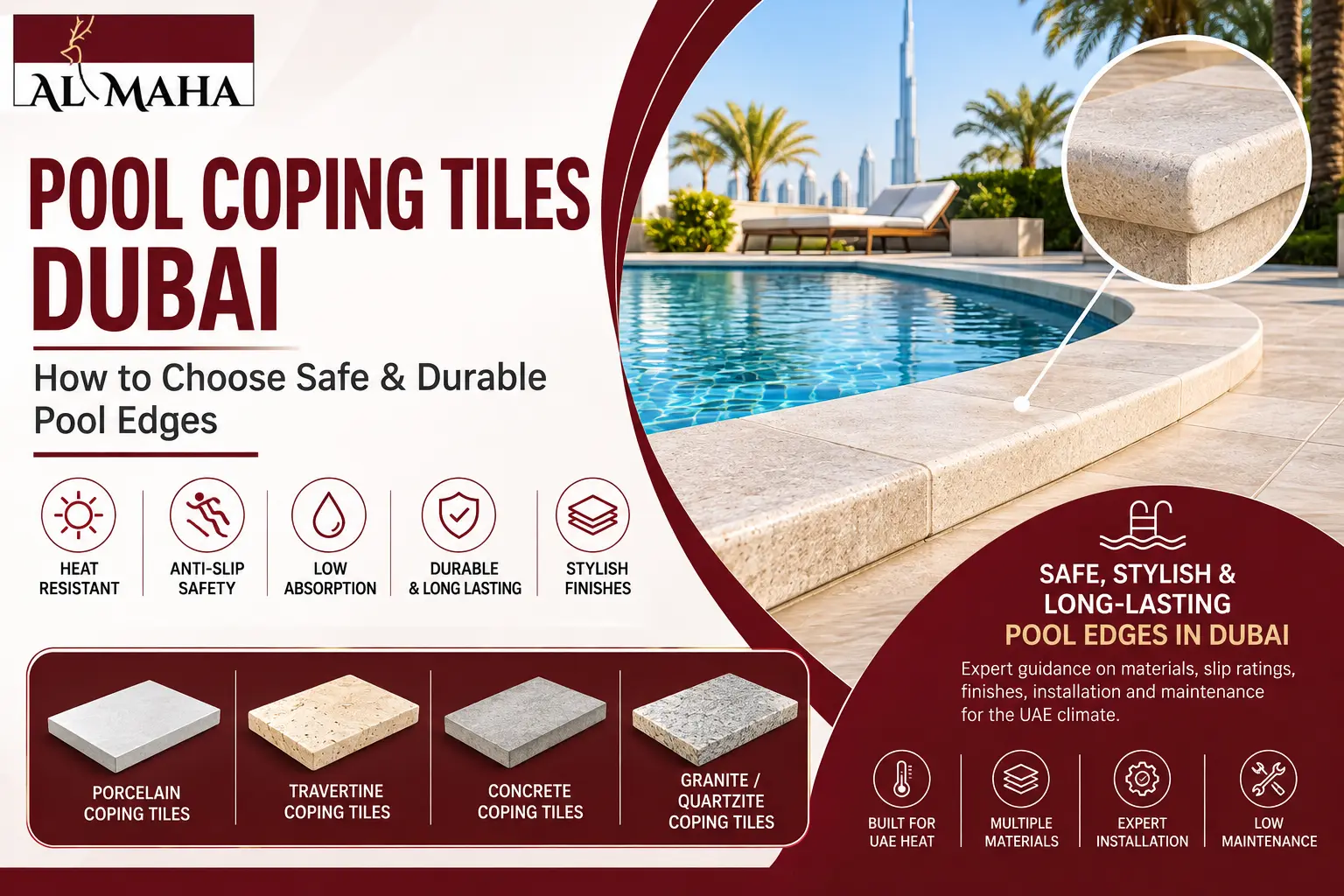
Pool Coping Tiles Dubai: How to Choose Safe & Durable Pool Edges
Your pool edge works harder than any other surface on the property. It takes bare feet, 45°C sun, chlorinated splash, windblown sand and a sharp drop in temperature after sunset. All of that lands on a strip of tile that is often just 30 to 40 cm wide.
Pick the wrong coping and you will see it fast. Hot surfaces. Slippery corners. Cracked edges. Joints that pop open after the first summer.
This guide shows you how to choose pool coping tiles in Dubai that stay safe, cool and intact. We cover climate, slip ratings, materials, salt pools, installation, cost and upkeep. Use it to brief your contractor or compare quotes with confidence.
What Are Pool Coping Tiles (and Why Do They Matter)?
Coping is the capping layer that finishes the pool wall where it meets the deck. It does three jobs:
Protects the structure. It covers the top of the pool shell and keeps water out of the edge.
Keeps people safe. It is the surface swimmers grab, step on and walk across, usually wet and barefoot.
Frames the pool. It sets the look of the whole outdoor space.
Because it does all three at once, coping is not the place to cut corners. If you are still comparing the wider pool finish, start with our guide to swimming pool tiles in Dubai and then come back to the edge.
1. Dubai Climate Factors: Heat, UV and Desert Sand
A pool edge in Dubai faces conditions that most European or North American guides never mention. Three factors matter most.
Solar Reflectance Index (SRI)
Dark, dense surfaces absorb heat and can burn bare feet by mid-morning. Look for coping with a high Solar Reflectance Index. A target of SRI 78 or above is a good rule of thumb for light-coloured, sun-exposed edges.
In practice, that means:
Choose ivory, sand, light grey or cream tones over charcoal or deep brown.
Ask the supplier for SRI or surface temperature data, not just a colour name.
Treat dark coping as a design choice that needs a shaded or cooled deck around it.
Thermal Shock
Summer days can pass 45°C. Pool water, splash and night-time air-conditioning runoff then cool the edge quickly. Tiles expand and contract every day.
Low-porosity tile handles this best. Look for water absorption below 0.5%, which is the porcelain range. Dense tile soaks up less water, so there is less moisture to expand and stress the body.
Sand Abrasion
Fine desert dust works like sandpaper on coatings. Soft film-forming sealers trap grit and wear unevenly. On natural stone, choose a penetrating sealer that sits inside the stone, not on top of it.
Quick takeaway: light colour, low absorption, no sticky surface coatings. That combination handles most of what Dubai throws at a pool edge.
2. Safety Standards: Anti-Slip Ratings Explained
A wet pool edge is a fall risk. Ratings give you a way to compare tiles with numbers instead of sales talk.
DIN 51097: The Barefoot Wet Test
This test measures slip resistance on wet surfaces when people walk barefoot. It uses three classes:
Class A: basic grip. Fine for dry-ish changing areas.
Class B: better grip. A common choice for pool surrounds and decks.
Class C: highest grip. Best for coping edges, steps and pool entries.
For most Dubai projects, aim for Class B on the deck and Class C on coping and steps. Confirm the exact requirement for your project with your consultant or the authority that approves it.
R-Ratings (R10 to R13)
R-ratings come from a ramp test with shoes and oil, so they suit mechanical grip on outdoor floors. For splash zones, R11 or R12 is a safer target. R10 is usually not enough where water, sunscreen and wet feet meet.
Use both systems together. DIN 51097 tells you how the tile behaves barefoot and wet. The R-rating tells you how the surface texture performs under load.
Edge Profiles
The shape of the edge matters as much as the texture of the face.
Bullnose: a rounded front edge. Comfortable to grip, kinder to children and a good fit for family pools.
Eased square edge: a clean, modern line. Make sure the corner is slightly radiused. A sharp arris is a cut waiting to happen.
If kids use the pool, lean towards bullnose. For a contemporary look, ask for eased edges and check a physical sample before you order.
For a deeper look at how surface finish affects grip and appearance, see our tile finish guide.
3. Material Comparison for UAE Pools
No single material wins on every point. Here is how the main options compare in local conditions.
Material | Heat underfoot | Slip resistance | Maintenance | Best for |
20mm exterior porcelain | Cool in light colours | Excellent with textured finish | Very low, no sealing | Modern villas, high-use family pools |
Tumbled Turkish travertine | Naturally cool | Good, naturally textured | Needs a quality penetrating sealer | Classic, warm, resort-style looks |
Precast concrete coping | Moderate | Good with textured finish | Low to moderate | Custom shapes, tighter budgets |
Granite or quartzite | Can run hot if dark | Good when flamed or textured | Low | Premium, long-life projects |
20mm Exterior Porcelain
This is the most practical all-rounder. It is dense, UV stable and does not need sealing. Colour stays consistent and stains rarely take hold. The 20mm thickness handles outdoor loads and gives coping a solid, substantial look.
Browse our range of porcelain tiles and read our guide to outdoor porcelain tiles in Dubai for finish and thickness advice.
Turkish Travertine (Tumbled)
Travertine stays comfortable underfoot and gives a natural, textured grip. The trade-off is porosity. It needs a good penetrating sealer and a re-sealing routine. In a salt pool, it needs extra care (more on that below).
Precast Concrete Coping
Precast works well when you need custom profiles, curves or a controlled budget. It is made in a factory, so quality depends heavily on the manufacturer. Ask about mix design, surface treatment and colour consistency.
Granite and Quartzite
Both are very durable. The catch is heat. Dark granite in direct sun gets hot quickly, so pick light tones and a flamed or textured face. Compare the options in our marble and granite range or read marble vs granite in Dubai.
For a wider look at stone choices, see our natural stone guide for Dubai.
4. Saltwater Pools vs Chlorine Systems
More Dubai villas are switching to saltwater chlorination. It feels softer on skin, but salt is tough on some building materials.
As salt water evaporates, it leaves crystals behind. In porous, soft stone, those crystals form beneath the surface and push outwards. This is called efflorescence and salt attack. The result is white staining, pitting and flaking.
What to avoid and what to choose:
Avoid soft limestone and weak sandstone around salt pools.
Choose porcelain, dense granite or well-sealed travertine.
Seal natural stone properly and keep to the re-seal schedule.
Rinse the coping with fresh water if splash dries and leaves a crust.
For chlorine-only pools, the main risk is chemical splash on grout and sealers. Dense, low-porosity tile again comes out ahead.
5. Installation Essentials and Grout Selection
A great tile fails if it is fixed badly. Most coping problems start under or between the tiles, not on the surface.
Adhesive
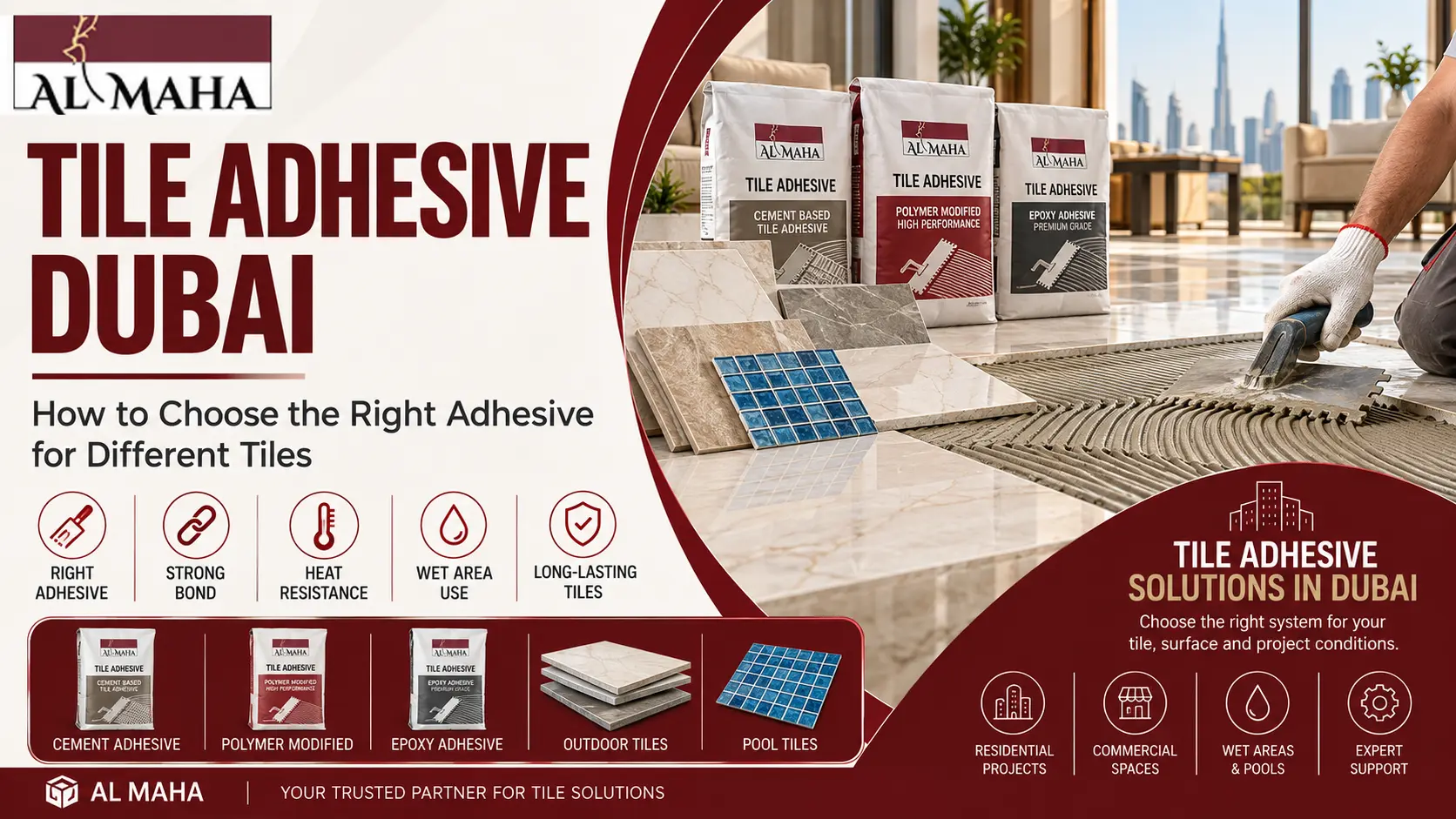
Use a Class C2TE S2 flexible tile adhesive. The S2 rating means high deformability, which helps the bond cope with daily thermal movement. For wet, outdoor and heavy-format work, a standard adhesive is not enough. Read our tile adhesive guide for Dubai and the specific porcelain tile adhesive guide. You can also see fixing products in our tile adhesive and glue range.
Full-bed adhesive coverage is important. Gaps under coping trap water and weaken the edge.
Grout
Your two main options are:
Epoxy grout: highly chemical resistant, low absorption and a strong choice for high-chlorine splash zones.
Polymer-modified cementitious grout: easier to work with, more budget-friendly and fine for many residential pools when applied well.
See our porcelain tile grout guide for joint width and colour tips.
Expansion Joints
Concrete decks move with temperature. If coping is rigid against the deck, something has to give, and it is usually the tile edge.
Leave a 6mm flexible polyurethane joint between the coping and the deck. Treat it as mandatory, not optional. It lets the two surfaces move independently and keeps water out. Skipping it is one of the most common reasons for edge tiles lifting.
For more on why tiles crack and how to prevent it, read how to prevent cracked porcelain tiles and our porcelain tile installation guide for Dubai.
Substrate Checklist
Before any tile goes down, confirm:
The pool shell and deck are fully cured.
The substrate is flat, clean and sound.
Falls drain away from the pool, not towards it.
Waterproofing is complete where the design calls for it.
6. Cost Guide and Sourcing in Dubai
Prices move with market conditions, stock and order size, so treat these as indicative planning ranges and confirm with a written quote. Figures are per linear metre for supply of coping only.
Material | Indicative supply cost (AED per linear metre) |
Precast concrete coping | 70 to 160 |
Turkish tumbled travertine | 90 to 200 |
20mm exterior porcelain coping | 120 to 260 |
Granite or quartzite coping | 180 to 400 |
Installation, adhesive, grout, sealing and the expansion joint come on top. Budget extra for site prep, cutting of curved sections and any waterproofing.
What Changes the Price
Pool shape. Curves and radii need more cutting and waste more material.
Edge profile. Bullnose usually costs more than a plain square edge.
Origin. Imported Italian porcelain costs more than regional options.
Order size. Larger batches help with both price and colour matching.
Sourcing Tips
Order all tiles in one batch to avoid shade differences.
Add around 10% extra for cuts and curves.
Ask for physical samples and test them wet.
Compare quotes line by line, not just the total.
Not sure who to buy from? Our guide on how to choose the best tile supplier in Dubai walks through what to check. For general pricing and planning, see the tile buying guide for Dubai.
7. Pool Coping Maintenance Checklist
Good coping lasts for years if you look after it. Here is a simple routine.
Weekly
Brush off sand and dust.
Rinse the edge with fresh water, especially near salt pools.
Monthly
Wash with a mild, pH-neutral cleaner and a soft brush.
Check grout lines and the expansion joint for gaps or cracks.
Look for loose or hollow-sounding tiles.
Calcium and Limescale
Hard water leaves white calcium rings along the waterline and edge. Remove them early with a cleaner made for pool surfaces. Avoid harsh acids and abrasive pads. They can strip anti-slip textures and dull the surface, which defeats the point of choosing a safe tile.
Sealing Natural Stone
Re-seal travertine and other porous stone every 1 to 2 years in Dubai conditions, or sooner if water stops beading on the surface.
Use a penetrating sealer rated for outdoor and pool use.
Porcelain does not need sealing. Epoxy grout needs none either.
Yearly
Renew any worn expansion joint sealant.
Repair chipped edges before water gets in.
Quick Decision Guide
Still unsure? Match your situation to a starting point:
Family pool, low upkeep: light 20mm porcelain with a bullnose edge.
Resort-style, natural look: tumbled travertine, well sealed.
Custom shape, tighter budget: quality precast with a textured finish.
Premium, long-life build: light granite with a flamed finish.
Saltwater pool: porcelain or dense granite first, sealed stone second.
Frequently Asked Questions
What is the best pool coping tile for Dubai?
For most villas, light-coloured 20mm exterior porcelain is the best balance of heat control, slip resistance and low upkeep.
What slip rating should pool coping have?
Aim for DIN 51097 Class B on the surrounding deck and Class C on coping edges and steps, with R11 or R12 on splash zones. Verify the exact requirement for your project.
Is travertine good for saltwater pools?
It can work if it is dense, properly sealed and rinsed regularly. Porcelain is the lower-risk choice.
Do I need an expansion joint between coping and deck?
Yes. A 6mm flexible polyurethane joint lets each surface move and prevents edge tiles from popping.
Final Thoughts
The best pool coping is the one that suits your pool, your sun exposure and your routine. Start with safety, then heat, then looks. Get the fixing details right and the edge will stay sound for years.
Ready to compare options? Browse our swimming pool tiles collection or contact the Maha Building Materials team for samples, advice and a written quote.
 02 Nov, 2026