- By Admin
- Floor
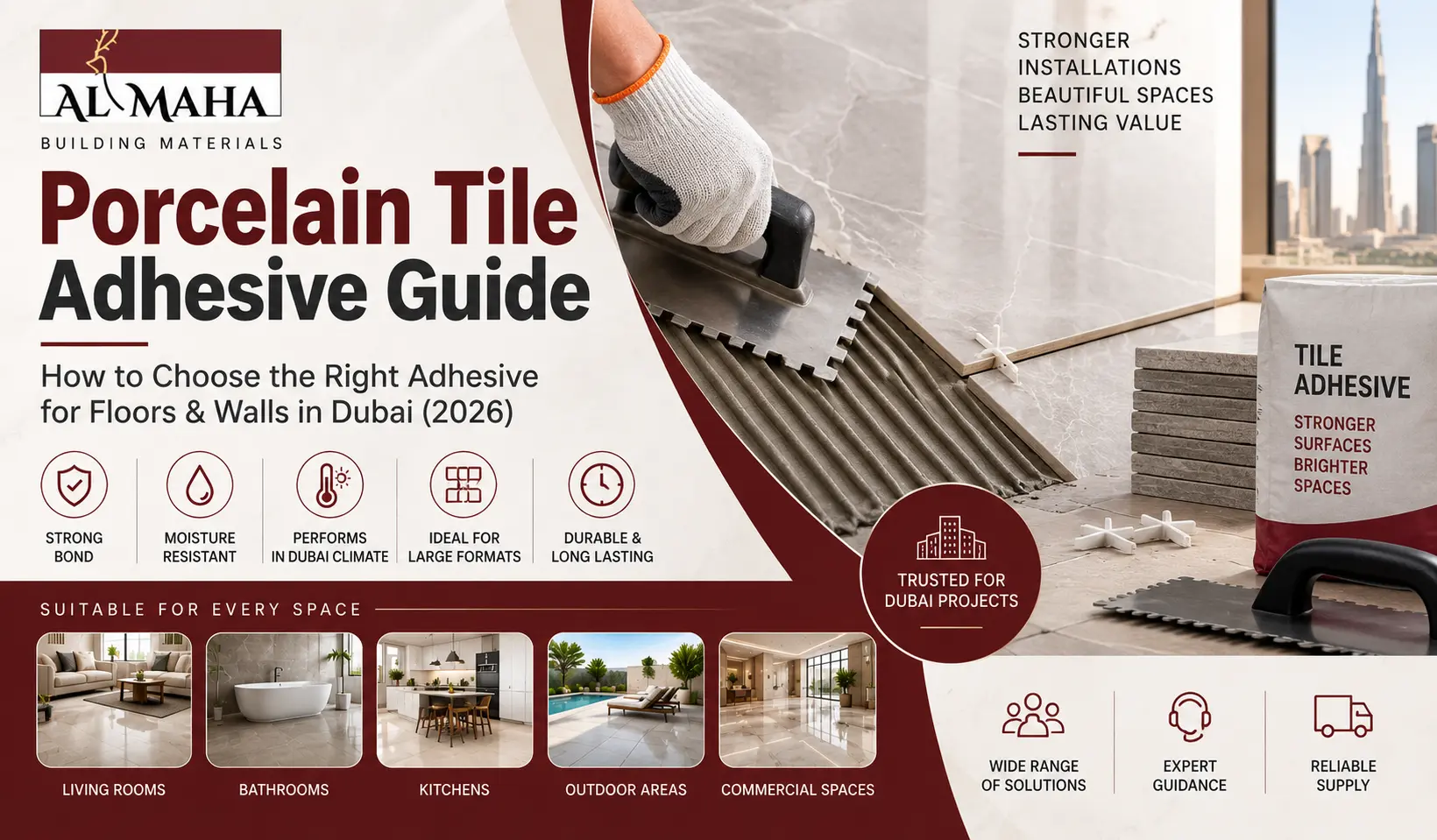
Porcelain Tile Adhesive Guide: How to Choose the Right Adhesive for Floors & Walls in Dubai (2026)
Choosing porcelain tiles is only part of a successful tiling project. The adhesive underneath the tile determines how securely it bonds and how well the installation holds up over time.
This matters even more with porcelain — and it matters more still in Dubai. Between low-porosity tile bodies, large formats, gypsum-partitioned high-rises, and a climate that regularly pushes exterior surfaces above 60°C, the margin for choosing the wrong adhesive is smaller here than almost anywhere else.
A tile can be high quality and still fail if the adhesive, substrate preparation, or coverage is wrong. The result: hollow-sounding tiles, debonding, cracking, or tiles slipping off walls. Adhesive selection should be based on tile type, tile size, substrate, location, moisture exposure, expected load, and installation method — not on which bag is cheapest.
What Is Porcelain Tile Adhesive?
Porcelain tile adhesive is a bonding material used to secure porcelain tiles to substrates such as concrete, cement screed, rendered walls, and other properly prepared surfaces.
Porcelain has very low water absorption — typically below 0.5% — compared with many conventional ceramic tiles (see our Porcelain vs Ceramic Tiles guide for the full comparison). Standard cement mortar relies on mechanical anchoring into a porous tile body as it cures. Porcelain gives it almost nothing to grip. The bond has to come from polymer chemistry, not suction, which is why the adhesive needs to provide reliable mechanical and chemical adhesion.
Modern adhesives come in different formulations and performance classes. Cementitious adhesives are the most widely used; reactive resin adhesives are reserved for more demanding applications. For large-format porcelain, deformable cementitious adhesives help accommodate movement between substrate and tile — MAPEI's installation guidance recommends high-adhesion C2 adhesives for large-format ceramic materials, with S1 or S2 deformability selected according to application and format.
Why Choosing the Right Adhesive Matters
The adhesive is the connection between two different materials:
Substrate → Adhesive → Porcelain Tile
Each part of that chain has to work together. A suitable adhesive provides:
Strong adhesion
Appropriate deformability
Good wetting of the tile back
Adequate open time
Suitable vertical slip resistance for wall applications
Compatibility with the substrate
Resistance appropriate to the installation environment
Reliable performance under expected loads
A small indoor wall tile, a 1200×1200mm porcelain floor slab, and an outdoor façade installation can all require very different adhesive performance. Choosing a product simply because the bag says "tile adhesive" isn't enough.
Decoding the EN 12004 Classification Codes
Every adhesive bag sold in the UAE carries an EN 12004 code — C2TE S1, R2, C1T, and so on. These aren't marketing jargon; they're a direct performance spec, and reading them correctly prevents most installation failures.
Code | Meaning | Why It Matters |
|---|---|---|
C1 | Standard cementitious adhesive | Suitable for less demanding applications |
C2 | Improved cementitious adhesive | Higher performance and adhesion — the minimum starting point for porcelain |
S1 | Deformable | Accommodates minor substrate/tile movement |
S2 | Highly deformable | Designed for greater movement, thermal stress, or large format |
T | Reduced vertical slip | Essential for wall tile installation |
E | Extended open time | More working time after application before it skins over |
R2 | Two-part reaction resin (epoxy) | Chemical-resistant, used for submerged or highly demanding applications |
A product marked C2TE S1 indicates an improved cementitious adhesive with reduced vertical slip, extended open time, and deformability. MAPEI's large-format installation guidance identifies C2 as the recommended high-adhesion class for large-format tile, with S1/S2 deformability selected according to application. The exact classification required should always be checked against both the tile manufacturer's installation requirements and the adhesive's technical data sheet.
Cementitious vs Reactive Adhesive
Cementitious adhesive — powder-based, mixed with water on-site. Widely used for porcelain floors and walls, residential and commercial projects, large-format tile, and both indoor and outdoor applications depending on the specific product. High-performance cementitious adhesives are available in deformable formulations built specifically for porcelain and large-format materials.
Reactive adhesive — formulated with reactive resins for particular demanding environments, such as constant water immersion or applications requiring enhanced chemical resistance. The correct choice depends on project conditions, substrate, and the manufacturer's technical recommendation.
Browse the full range of tile adhesives available from Al Maha to compare classifications and formulations.
Choosing Adhesive for Porcelain Floor Tiles
Floor applications need an adhesive capable of handling the expected mechanical load and movement of the installation.
Tile size. Small tiles and large-format slabs don't behave the same way during installation. Large tiles need careful adhesive selection because achieving consistent contact across the full tile becomes harder as size increases. MAPEI's installer manual recommends high-wetting adhesives for large-format tile and notes that double-buttering can be required for large-format installations, heated substrates, façades, and areas exposed to high mechanical or thermal stress.
Substrate condition. The floor should be strong, stable, properly cured, clean, and free of dust, oil, grease, and loose material. No adhesive compensates for a structurally weak or poorly prepared substrate.
Expected traffic. A residential bedroom has different demands than a shopping mall, hotel lobby, or restaurant floor. Commercial floors with heavy traffic often need a higher-performance system — certain S1 deformable adhesives are specifically designed for large porcelain floor slabs in heavy-traffic settings.
Choosing Adhesive for Porcelain Wall Tiles
Wall installation adds one more requirement: vertical slip resistance. The adhesive needs to hold the tile in place while it cures, without the tile sliding down under its own weight.
Look for:
Reduced vertical slip (the T classification)
Suitable open time
Good initial grab
Appropriate deformability
Strong adhesion
Compatibility with the wall substrate
Large-format wall tiles need particular care — their weight and dimensions raise the stakes on correct adhesive coverage and technique. Some large-format adhesives are formulated for both floor and wall use, with a thixotropic (gel-like, non-slumping) consistency built to stop tiles sliding on vertical surfaces before they set.
The Dubai Climate Problem Most Guides Skip
Most tile adhesive is engineered and tested in European conditions. Dubai isn't Europe, and the gap shows up in two specific, measurable ways that generic "hot climate" advice doesn't capture.
Thermal shock on outdoor surfaces. A balcony or terrace tile in direct Dubai sun can exceed 60°C in the afternoon, then drop sharply once shaded or after sunset. That daily swing puts real shear stress on the bond line. A standard C2 adhesive is rated for normal conditions — it isn't built to absorb repeated expansion and contraction at that scale. Over a year or two, the bond fatigues, tiles start drumming hollow near the edges, and eventually they lift. The fix: specify C2TE S2 for any exterior application — terraces, balconies, pool decks, and façades. The extra flexibility class isn't optional here; it's the difference between a 10-year installation and a 2-year one.
Rapid skinning in low humidity. Dubai's air is dry and fast-moving, especially with wind exposure on an open site. Standard thinset that should offer 20–30 minutes of open time can skin over in under 10. Once a skin forms, the tile is being pressed onto a semi-cured surface instead of a wet, workable one — it looks fine on day one and fails months later. The fix: for outdoor work, large-format tile, or any job where several tiles go down before grouting, use an E (extended open time) grade, and lightly mist the substrate in extreme conditions.
HVAC-driven wall stress. Internal walls in Dubai live a double life — blasting exterior heat on one side, constant air conditioning on the other. That differential creates condensation risk within the wall assembly and ongoing, low-level movement at the substrate. For interior walls backed by exterior exposure, a basic C1 wall adhesive isn't enough; a C2S1 product handles that movement without the bond line cracking over time.
Outdoor porcelain applications where this matters most include terraces, balconies, outdoor walkways, pool surrounds, garden areas, exterior walls, and commercial outdoor spaces. Some high-performance systems are specifically approved for both indoor and outdoor porcelain, including heated floors and heavy-traffic zones — always check the technical data sheet before assuming a product covers exterior use. For more on selecting tile itself for these conditions, see our Outdoor Porcelain Tiles Dubai guide.
Porcelain Tile Adhesive for Bathrooms
Bathrooms combine moisture, water exposure, frequent cleaning, temperature change, vertical surfaces, and floor traffic all in one space.
For shower walls and other wet areas, the adhesive works alongside a full waterproofing system — it isn't the waterproofing layer itself. Before installation, confirm the substrate is suitable, waterproofing requirements are addressed, the adhesive is approved for the application, the tile manufacturer permits the installation system, and the grout and sealant are compatible with the rest of the build-up (see our Porcelain Tile Grout Guide for more). For pool tiling or anything under constant water immersion, step up to a two-part epoxy (R2) system rather than a cementitious one — browse our swimming pool tile range for suitable options.
Porcelain Tile Adhesive for Kitchens
Kitchens see moisture, food spills, cleaning chemicals, foot traffic, temperature swings, and heavy appliances. For kitchen floors, select adhesive based on tile size, substrate, and traffic. For kitchen walls, vertical slip resistance and workable open time matter most, especially with larger-format tile. Treat the adhesive as part of the whole tiling system rather than a standalone choice.
Matching Adhesive to Substrate
Concrete screed (most villas and older buildings): standard C2 or C2TE works well once the screed is fully cured and dust-free. Check moisture content before tiling over new screed — rushing this is a common failure point.
Gypsum board / drywall (common in Dubai high-rises across Downtown, Marina, and JVC): gypsum absorbs moisture unevenly, so it isn't a natural match for a wet-mix adhesive straight out of the bag. Prime with an acrylic bonding primer first, then use an R2 or C2TES1 adhesive rated for gypsum substrates. Skipping the primer is one of the most common causes of debonding on drywall.
Tile-on-tile / cladding: requires a high-bond adhesive rated specifically for the application, paired with a primer on the existing glazed surface — see our cladding tiles fixing range for façade and re-cladding projects.
Adhesive Selection by Tile Size
Tile Application | Key Adhesive Considerations |
|---|---|
Small indoor tiles | Standard or improved adhesive per tile/substrate |
Medium porcelain tiles | Improved adhesion may be appropriate |
Large-format floor tiles | High adhesion, good wetting, deformability |
Large-format wall tiles | High adhesion, deformability, reduced vertical slip |
Outdoor porcelain | Exterior-rated, deformable (C2TE S2) system |
Heavy-traffic areas | High-performance adhesive |
Heated floors | Adhesive compatible with thermal movement |
Façades | Specialized high-performance system |
This is a guide, not a universal spec — the manufacturer's technical data sheet should always determine final product suitability.
Why Coverage — and Double-Buttering — Matters
A high-quality adhesive can still perform poorly if it isn't applied correctly. Large-format tiles are especially sensitive to incomplete contact: voids beneath the tile create weak points that contribute to cracking or debonding under load. MAPEI's guidance highlights double-buttering as an installation method specifically for large tiles and demanding applications, alongside proper adhesive wetting. The goal is a continuous, void-free adhesive layer — not isolated spots of contact.
Double-buttering means applying adhesive to both the prepared substrate and the reverse side of the tile. It's particularly relevant for:
Large-format tiles (60×120cm and above)
Long-format tiles
Outdoor installations
Heated substrates
Façades
Areas exposed to high mechanical or thermal stress
Follow the adhesive manufacturer's technical instructions for the precise method.
Surface Preparation Before Applying Adhesive
Substrate preparation is one of the most important — and most skipped — stages of porcelain installation. The surface should generally be sound, clean, stable, suitably cured, free of dust, free of grease and oil, free of loose coatings, and appropriately flat. MAPEI's technical documentation specifically requires substrates to be even, strong, and free from crumbling areas, grease, oil, varnish, and wax. For a full walkthrough, see How to Prepare Your Floor Before Installing Porcelain Tiles.
Common Porcelain Tile Adhesive Mistakes
Choosing adhesive on price alone — compare technical performance, not just bag cost.
Using a basic adhesive for large tiles — large-format porcelain often needs higher adhesion and deformability than standard C2.
Ignoring the substrate — even the best adhesive can't correct a structurally unsuitable surface.
Applying too little adhesive — insufficient coverage creates voids beneath tiles.
Ignoring open time — tile within the manufacturer's specified working window, not after.
Adding too much water when mixing — changes the adhesive's performance characteristics.
Using the same product everywhere — a bedroom floor, outdoor terrace, and large-format bathroom wall have different requirements.
Skipping the technical data sheet — the bag label has the basics; the TDS has the detail that actually matters.
How to Apply Porcelain Tile Adhesive
Prepare the substrate — clean, sound, cured, and flat.
Select the correct adhesive — based on tile format, substrate, location, and environment.
Mix correctly — MAPEI's installer manual recommends mixing powdered adhesive with the specified water or latex ratio until smooth and lump-free, letting it stand briefly, then remixing before use.
Apply with the correct trowel — notch size depends on tile size, substrate condition, and adhesive requirements.
Achieve proper coverage — large-format tiles may need additional adhesive on the tile back (double-buttering).
Position the tile — careful alignment and full contact.
Respect adjustment and open times — don't keep working adhesive that's exceeded its usable window.
Allow proper curing — follow the manufacturer's timing for foot traffic, grouting, and full service.
How Much Adhesive Do You Need?
Consumption depends on tile size, trowel size, substrate flatness, adhesive thickness, application technique, and whether double-buttering is required. As a rough baseline for cementitious adhesive:
Small to medium tiles (up to 30×30cm): roughly 3–4 kg per square meter
Medium to large tiles (30×60cm to 60×60cm): roughly 4–5 kg per square meter
Large format (60×120cm+) with back-buttering: 6–8 kg per square meter, since coverage applies to both surfaces
A flatter substrate needs less correction than an uneven one. Avoid estimating purely from floor area — calculate from the selected product's published consumption rate and actual site conditions, and round up.
White or Grey Adhesive?
Grey adhesive covers most standard porcelain applications. White adhesive is often preferable for light-coloured or translucent materials, and for applications where colour transfer or visual bleed-through is a concern. Follow the adhesive and tile manufacturer's recommendation — many current high-performance products are available in both colours.
What to Check on an Adhesive Bag
Product name, manufacturer, classification, and intended application
Technical performance: adhesion, deformability, open time, slip resistance, setting time, temperature range
Application suitability: floor/wall, indoor/outdoor, large-format, heavy traffic, heated floor
Installation requirements: mixing ratio, recommended thickness, trowel size, coverage, pot life, curing time
Always cross-check against the current technical data sheet before final specification.
Dubai Projects: Certification and Compliance
For construction and renovation projects in Dubai, documentation matters as much as the technical spec. Dubai Municipality operates product certification and conformity processes for construction-related products, including ceramic tile and adhesive products under applicable schemes. For a commercial or professionally managed project, ask the supplier or contractor for the product's technical data sheet, applicable classification, manufacturer information, application instructions, and conformity/certification documentation where relevant.
Exterior cladding and façade work should also be checked against Dubai Civil Defense requirements around non-flammable adhesive systems, and interior work increasingly calls for low-VOC formulations under Dubai Municipality's green building guidance — most major suppliers now offer compliant products without a price premium.
Porcelain Tile Adhesive Selection Checklist
What size are the porcelain tiles?
Floor or wall installation?
Indoor or outdoor?
What substrate is being used?
Is the substrate properly cured, level, and structurally sound?
Is the area exposed to moisture?
Will it see heavy traffic?
Is the floor heated?
Does the installation need deformability (S1/S2)?
Is reduced vertical slip (T) needed?
Is double-buttering recommended?
Does the adhesive meet the required classification?
Has the technical data sheet been reviewed?
Is the product suitable for this specific porcelain tile?
Quick Decision Guide
Project | Key Requirement |
|---|---|
Bedroom floor | Suitable high-quality cementitious adhesive |
Living room | Adhesive matched to tile size and substrate |
Kitchen floor | Strong adhesion and application suitability |
Bathroom wall | Adhesion + vertical slip control |
Shower area | Suitable adhesive + proper waterproofing system |
Large-format living room | High adhesion + deformability + high wetting |
Outdoor terrace | C2TE S2 exterior-rated deformable adhesive |
Pool area | Product specifically approved for the application |
Commercial floor | High-performance adhesive matched to traffic |
Large-format wall | High adhesion + deformability + reduced slip |
Heated floor | Adhesive compatible with thermal movement |
Gypsum wall (high-rise) | Acrylic primer + R2 or C2TES1 adhesive |
How Al Maha Can Help With Porcelain Tile Projects in Dubai
Selecting the right adhesive should happen alongside selecting the right tile. Al Maha Building Materials supplies porcelain tiles in Dubai across multiple formats, including 600×600mm, 800×800mm, 600×1200mm, and 1200×1200mm, along with large-format slabs — in polished, matte, lappato, textured, and anti-slip finishes (see our Tile Finish Guide for how to choose between them).
Explore the Al Maha porcelain tile collection to compare available formats and finishes. For preparation and technique, see our Porcelain Tile Installation Guide, and for choosing the right format for your space, check the Porcelain Tile Sizes Guide. Have questions about a specific project? Get in touch with our team.
Final Thoughts
Porcelain tile adhesive selection depends on tile size, substrate, location, moisture, movement, traffic, and installation method — together, not in isolation. For standard indoor applications, an appropriate cementitious adhesive is often sufficient. Large-format porcelain, outdoor areas, heated floors, commercial environments, and demanding wall installations call for higher-performance, deformable systems — and in Dubai specifically, the daily thermal swing on exterior surfaces makes that choice non-negotiable rather than a nice-to-have.
For Dubai projects, pay attention to technical documentation, product suitability, and applicable conformity requirements. A high-performance adhesive cannot compensate for poor substrate preparation, insufficient coverage, or incorrect technique. Treat the tile and the adhesive as one complete system, and the installation that looks good on day one still looks good in year ten.
Frequently Asked Questions
What is the best adhesive for porcelain tiles?
It depends on tile format, substrate, and application. Most porcelain installations need an improved cementitious adhesive (C2) with appropriate deformability. Large-format and demanding applications may need S1 or S2 systems.
Can porcelain tiles be installed on walls?
Yes, when the substrate, tile weight, adhesive, and installation method are suitable. Large-format wall tiles need particular attention to coverage and vertical slip resistance.
Is C2 adhesive suitable for porcelain tiles?
C2 is an improved cementitious classification commonly specified for demanding ceramic and porcelain installations. Required deformability depends on the specific project.
What does S1 mean in tile adhesive?
S1 indicates a deformable adhesive classification — MAPEI's technical guidance defines it as having transverse deformability of at least 2.5mm under the relevant classification system.
Do large-format porcelain tiles need special adhesive?
Generally yes — larger tiles, more substrate movement, and higher coverage requirements call for high-adhesion, deformable adhesives with good wetting characteristics.
Can the same adhesive be used indoors and outdoors?
Some products are formulated for both, but not all. Always check the technical data sheet before using any adhesive outdoors — Dubai's thermal swings make this especially important.
Is double-buttering necessary for porcelain tiles?
Not for every installation, but it's important for large-format tiles and demanding applications needing continuous adhesive contact. Follow the manufacturer's instructions.
Can tile adhesive fix an uneven floor?
No. Adhesive isn't a substitute for proper substrate preparation — the surface needs to meet flatness, strength, and cleanliness requirements before tiling begins.
How long should porcelain tile adhesive cure?
It varies by product, temperature, substrate, and site conditions. Always follow the technical data sheet for grouting, foot traffic, and full-service timing.
How do I choose porcelain tile adhesive in Dubai?
Start with tile size, substrate, and application area. Then check classification, deformability, indoor/outdoor suitability, moisture exposure, traffic requirements, and technical documentation. For commercial projects, also verify applicable conformity requirements.
 20 Oct, 2026