- By Admin
- Floor
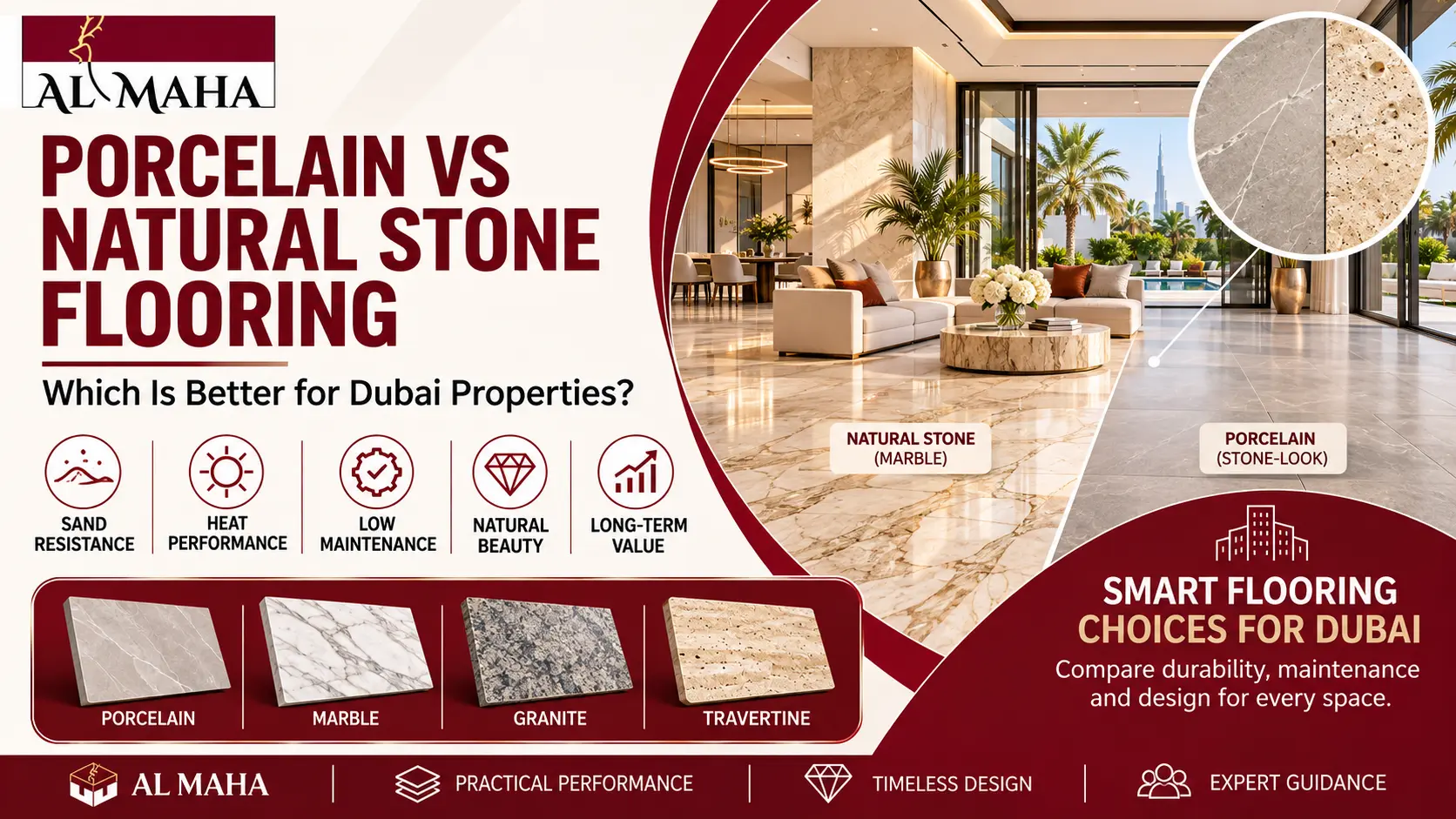
Porcelain vs Natural Stone Flooring: Which Is Better for Dubai Properties?
Pick the wrong floor in Dubai and you will know within a year. Polished marble turns hazy under fine desert sand. A dark stone entrance shows every mineral spot from desalinated water. A sun-baked terrace gets too hot for bare feet.
Porcelain and natural stone can both look stunning. They behave very differently here. This guide compares them the way Dubai property owners actually live with them: sand, heat, water, building rules, budget and resale.
The Short Answer
There is no single winner. But there is a clear pattern.
Choose porcelain for apartments, rentals, outdoor areas, kitchens, bathrooms and busy family homes.
Choose natural stone for feature spaces in luxury villas, where genuine material adds prestige and resale appeal.
Mix both in most homes. It is usually the smartest and most cost-effective route.
The rest of this article shows why.
What You Are Actually Comparing
Porcelain
Porcelain is made from fine clay and minerals, pressed and fired at temperatures above 1,200°C. The result is dense, hard and very low in water absorption (typically under 0.5%).
Modern digital printing lets it copy marble, travertine, limestone, concrete and wood with surprising accuracy. Large-format slabs, some reaching 160×320 cm, cover big areas with very few grout lines. You can browse the range in our porcelain collection.
Natural Stone
Natural stone is cut from the earth. Marble, granite, limestone, travertine, slate and quartzite all fall into this group. Each slab carries its own veining, fossils and colour shifts. No two are identical.
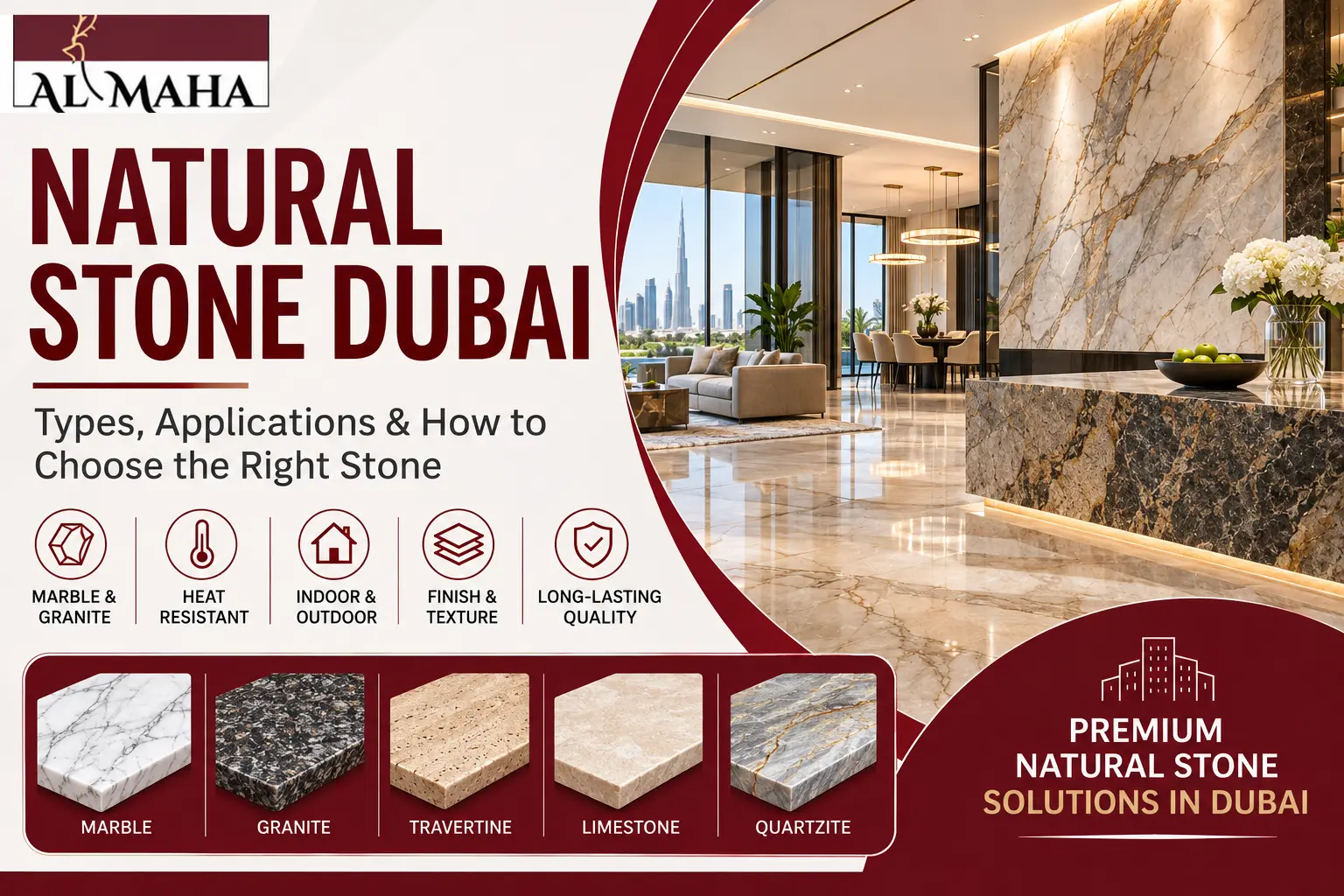
Stone is also porous to varying degrees. That one trait drives most of the maintenance differences below. For a full breakdown of stone types, see our guide to natural stone in Dubai, or explore our marble and granite range.
Looks and Design Flexibility
Natural stone wins on authenticity. Book-matched marble, with veins mirrored across two slabs, is hard to beat in a formal living room. It feels rare because it is rare.
Porcelain wins on consistency. You can order 80 square metres that match. You can also get the marble look without the risk of a surprise crack line or a patchy batch.
A few practical points:
Stone-look porcelain has improved enormously. Most guests cannot tell the difference at a glance.
Natural stone develops a patina over time. Some owners love this. Others see it as wear.
Porcelain keeps its original finish for years.
Both come in polished, matte and textured surfaces. Our tile finish guide explains which suits which room.
Durability in Dubai's Climate
Global comparison articles skip this part. In Dubai, climate decides everything.
Fine Desert Sand
Wind-blown silica sand is hard and sharp. Carried in on shoes, it works like sandpaper on the floor.
Porcelain copes well. Glazed tiles carry a PEI abrasion rating. For ground-floor villa entrances and busy corridors, look for PEI 4 or 5. Through-body or unglazed porcelain hides wear even better.
Polished marble and limestone are softer. Sand dulls the shine, especially near doors and in walkways. Expect periodic crystallisation or buffing to bring the gloss back.
Tip: Put a quality entrance mat at every exterior door. It protects any floor, and it costs far less than restoration.
Extreme Heat and Pool Decks
Summer surfaces can pass 45°C. On terraces and pool decks, two things matter: how hot the surface gets, and how well it handles thermal shock.
Light-coloured travertine (especially tumbled) stays relatively cool underfoot.
Textured R11 porcelain is dimensionally stable, resists thermal shock and offers strong grip when wet.
Dark, smooth surfaces of any material get uncomfortably hot in direct sun.
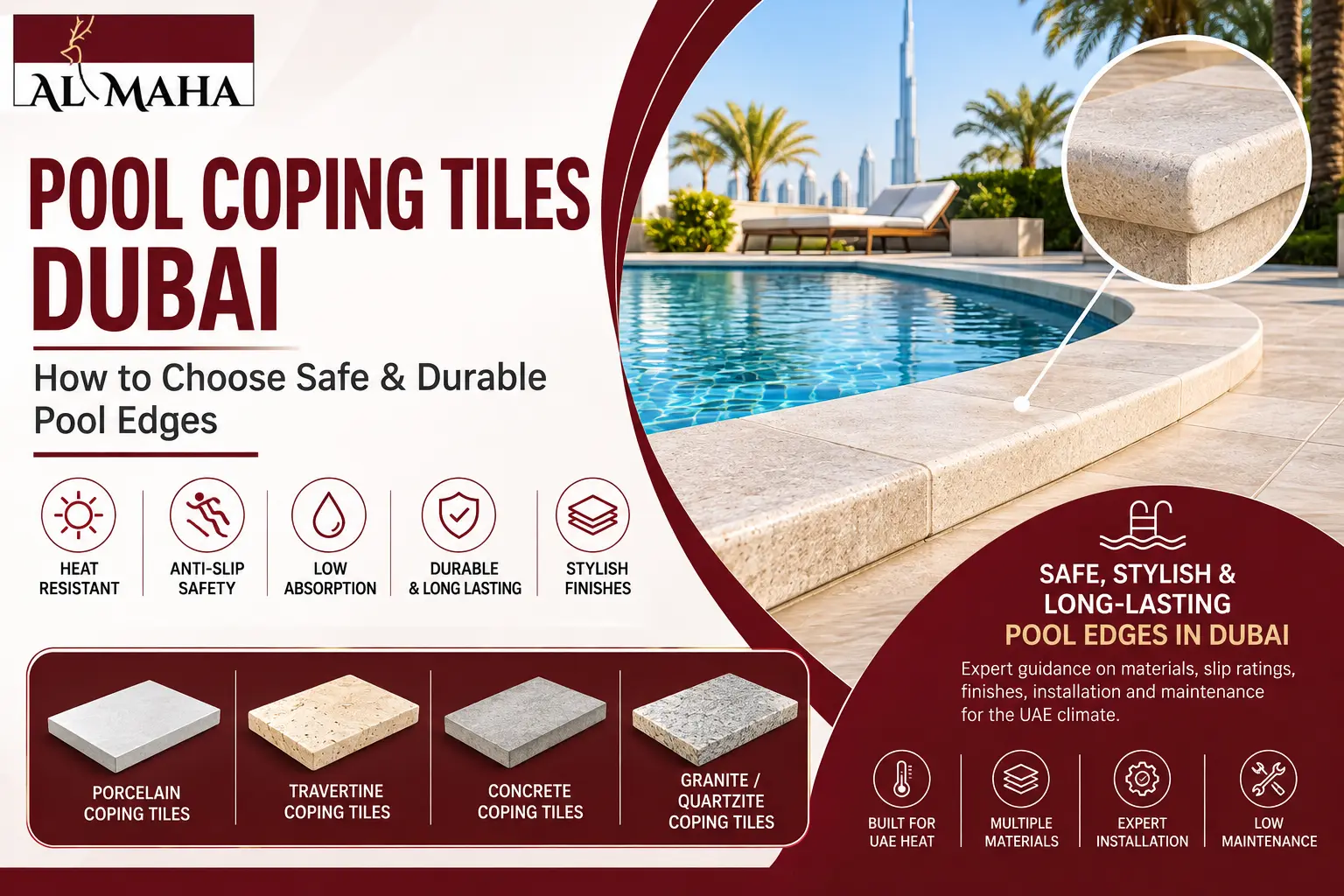
When comparing outdoor options, check the Solar Reflectance Index (SRI) where the supplier provides it. Higher means cooler. For pool edges specifically, read our guide to pool coping tiles in Dubai and browse swimming pool tiles. For terraces and patios, see outdoor porcelain tiles in Dubai.
Hard Water and Humidity
Dubai's water is largely desalinated. Mopping with it leaves mineral deposits behind. On dark polished stone, these show up as a white haze.
Worse, many household descalers are acidic. Acid etches marble and limestone, leaving permanent dull patches. Bleach-based cleaners can also damage unsealed stone.
Porcelain simply shrugs this off. Wipe, rinse, done.
This matters beyond bathrooms. Kitchens, laundry rooms, entrance halls and balconies all see regular wet cleaning.
Maintenance: Real-World Effort
Porcelain
Clean with water and a pH-neutral cleaner.
No sealing of the tile itself.
Grout needs occasional cleaning. Epoxy grout reduces that work. See our porcelain tile grout guide.
Natural stone
Seal on installation, then reseal roughly every 12 to 18 months, depending on the stone and traffic.
Use stone-safe cleaners only.
Wipe spills quickly, especially oil, wine, coffee and citrus.
Marble and limestone may need professional crystallisation or honing over time.
None of this is hard. It is simply ongoing. If you are the sort of owner who books regular maintenance, stone is fine. If you want a floor you can forget about, choose porcelain.
Cost in AED: Upfront and Over Five Years
Prices below are indicative market ranges for supply and fitting in the UAE. They move with brand, origin, thickness and project size. Treat them as a planning guide and request a firm quote before you budget.
Cost item | Porcelain | Natural stone (marble, limestone) |
Material, local or regional | AED 45–130 per m² | AED 150–400 per m² |
Material, premium imported (e.g. Italian) | AED 150–400+ per m² | AED 400–900+ per m² for premium marble |
Installation labour | Lower to moderate | Moderate to high (heavier, more skilled work) |
Adhesive and grout | Standard polymer-modified adhesive | White polymer-modified adhesive to avoid staining, often epoxy grout |
Sealing and upkeep | Minimal | Initial sealing plus regular resealing and polishing |
Typical 5-year upkeep | Close to zero | A noticeable recurring cost |
What this means:
Porcelain usually costs less on day one and far less over five years.
Premium Italian porcelain can approach the price of mid-range stone. You are paying for design and finish, not necessity.
Stone's real cost sits in the maintenance column, not just the invoice.
For adhesive choices, read our porcelain tile adhesive guide.
Weight, Thickness and Installation
Stone is heavy. Porcelain slabs are light by comparison, and thin options of 6 mm to 10 mm are now common.
Stone may need floor-load checks, extra labour and specialist fitters.
Large-format porcelain needs skilled handling too. Big slabs crack if the substrate is uneven or the adhesive coverage is poor.
Both depend on a flat, clean, stable base.
Good preparation prevents most failures. Our guides on preparing the floor, preventing cracked porcelain tiles and the porcelain installation process in Dubai cover the details. If you are considering big slabs, start with large-format porcelain in Dubai.
Apartments vs Villas
High-Rise Apartments
Building management often limits what you can do. Typical concerns are floor loading, noisy wet-cutting, delivery routes and lift access for heavy slabs.
That favours thin porcelain. It is lighter, easier to carry and quicker to install. Where acoustic underlay is required, porcelain pairs with it easily.
Luxury Villas
In communities such as Palm Jumeirah, Emirates Hills and Dubai Hills, buyers often expect genuine stone in formal areas. A well-finished marble foyer or majlis can lift perceived value.
There is more freedom here, so you can mix materials by zone.
Rentals and Holiday Homes
Landlords and short-stay investors should lean towards porcelain. It resists stains, scratches and heavy turnover. You avoid restoration bills and deposit disputes between tenants.
If you are comparing options for flooring across a whole property, our floor tiles buying guide is a good companion read.
Developer Rules and NOCs
Before you rip anything up, check the paperwork.
In most master-planned communities and apartment towers, flooring changes need a No Objection Certificate (NOC) from the developer or building management. Emaar, Nakheel and Dubai Properties communities each have their own process.
Management may specify working hours, protection of common areas and acoustic underlay.
Rules vary by community and building, so confirm with your property manager first.
Skipping this step can delay your project or force rework. It takes a short email to avoid.
The Hybrid Zone Blueprint for Dubai Homes
Stop treating this as all-or-nothing. Use each material where it performs best.
Zone | Best choice | Why |
Foyer and formal majlis | Book-matched natural marble | Maximum impact and resale appeal |
Family living room | Matte stone-look porcelain | Looks premium, handles kids, pets and sand |
Bedrooms | Wood-look or soft stone-look porcelain | Warm, quiet and easy to maintain |
Kitchen | Porcelain or sintered slab | Stain-resistant and wipe-clean |
Bathrooms | Anti-slip porcelain | Handles water, steam and cleaners. See luxury bathroom tiles |
Patio and sahn | R11 textured porcelain | Grip, heat tolerance, low upkeep |
Pool deck | Light travertine or R11 porcelain | Stays cooler, safer when wet |
This approach spends your budget where guests see it and saves it where wear is heaviest. For kitchens in particular, our kitchen tile guide goes deeper.
Quick Decision Guide
Go porcelain if you:
live in an apartment with building restrictions
rent out or run a holiday home
have children, pets or heavy foot traffic
want low maintenance and predictable cost
need outdoor flooring that handles sun and water
Go natural stone if you:
own a villa and want a true showpiece entrance or majlis
value one-of-a-kind patterns
accept regular sealing and polishing
plan to stay long enough to enjoy the patina
Go hybrid if you:
want the best of both without paying for stone everywhere
Common Questions
Is porcelain really as good as marble?
For performance, usually better. For prestige and uniqueness, marble still leads. The gap in appearance is smaller every year.
Does natural stone add more resale value in Dubai?
Genuine stone in key rooms of a high-end villa can help. In apartments and mid-market homes, buyers care more about condition and low upkeep, so quality porcelain holds its own.
Which is better for outdoor areas in Dubai?
R11-rated porcelain is the safer all-round choice. Light travertine also works well when properly sealed and maintained.
Can I use polished porcelain everywhere?
Not everywhere. Polished surfaces get slippery when wet. Use matte or anti-slip finishes in bathrooms, balconies and pool areas.
How do porcelain and ceramic differ?
Porcelain is denser and less absorbent than ceramic. Our comparison of porcelain vs ceramic tiles in Dubai explains when each makes sense.
Final Verdict
Porcelain is the practical champion for most Dubai properties. It handles sand, heat and hard water without fuss, and it keeps long-term costs low.
Natural stone is the statement maker. Use it where it counts, and give it the care it needs.
The best floor plan blends the two. Marble where guests walk in, porcelain where life happens.
Plan Your Floors With Maha Building Materials
Not sure which material fits your property? Browse our full product categories, compare porcelain and marble and granite options, or contact our team for samples and a quote tailored to your villa, apartment or project.
 16 Nov, 2026